

The 50 Year Mortgage Rumor Everyone Is Talking About and What It Could Cost You
By: Jill Franks + Ashley McVicker
| Apple | Spotify | YouTube |
If you have been scrolling social media or watching financial news lately, you have probably seen the phrase “50 year mortgage” floating around. At first glance, it sounds like the magic fix. Stretch the loan out longer and suddenly those sky-high home prices start to look “affordable,” right?
Not so fast.
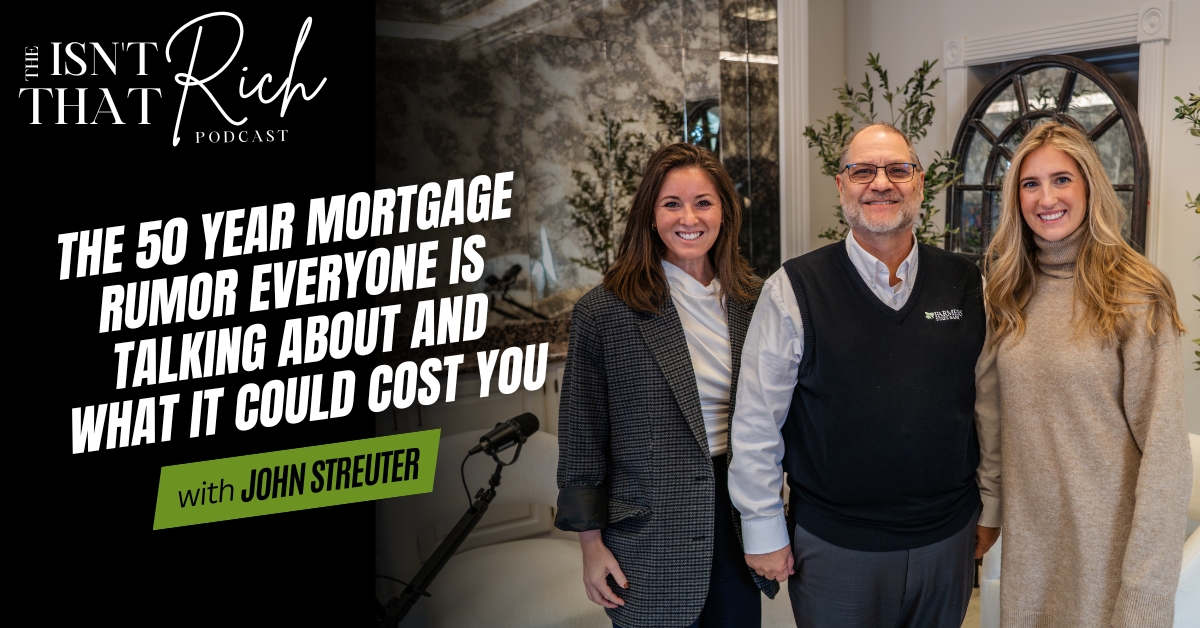
We sat down with our Chief Mortgage Officer, John Streuter, to unpack what a 50 year mortgage really means for buyers, banks, and the housing market, especially here in Southern Illinois.
Before we go any further, let’s be clear. This is all just hearsay for now. Nothing concrete has been passed or approved. But for what it is worth, here is our honest opinion.
What Is a 50 Year Mortgage, Really?
A 50 year mortgage is exactly what it sounds like. Instead of paying off your home over 15, 20, or 30 years, you would pay it off over 50 years. Half a century.
The idea is being floated as a way to make homeownership more accessible. Home prices have jumped, everyday living is more expensive, and people are struggling to make the math work. So the pitch is simple.
“If we cannot lower prices, let’s lower payments.”
This concept would almost certainly start with government-backed programs like FHA, VA, or USDA. Once those open the door, other investors and lenders usually follow to stay competitive.
So while it does not exist yet, it could spread quickly if ever adopted.
A Quick Look Back at How We Got the 30 Year Mortgage
The 30 year mortgage is not as old as you think.
Before 1934, the typical mortgage term was 15 to 20 years. After the Great Depression, President Franklin D. Roosevelt and the FHA established the 30 year mortgage to make monthly payments more manageable and stimulate homebuilding.
By the 1960s, it became the standard. That is the world we have grown up in.
So when we talk about a 50 year mortgage, we are not talking about a small adjustment. We are talking about a major change in the way homeownership works.
Why Longer Loans Feel Cheaper: A Look at Car Loans
To understand why a 50 year mortgage sounds appealing, John compares the situation to car loans.
Years ago, 36 to 48 month car loans were the norm. Today, 72, 84, and even 90 month car loans are common. Why?
Because buyers care most about one thing. The payment.
Instead of addressing the price of the car, lenders stretch the term to make the payment feel comfortable. We are doing the same thing with houses now.
Many buyers in our market feel like a “comfortable” mortgage payment should be around $1,000 to $1,500 per month because that is what they pay in rent. Stretching the mortgage out longer is an attempt to hit that number even as home prices rise.
Does a 50 Year Mortgage Actually Lower Your Payment?
Here is where the shock comes in. John ran the numbers on a $100,000 loan.
• A 30 year mortgage costs about $632 per month.
• A 50 year mortgage costs about $602 per month.
That is a savings of $30.
Let’s look at the total cost over time.
• A 30 year mortgage ends up costing you about $227,500 total.
• A 50 year mortgage ends up costing you about $361,000 total.
On a 50 year mortgage, you pay for the house about three and a half times.
Now let’s look at a $500,000 loan.
• 30 year payment: about $3,160
• 50 year payment: about $3,008
This is only a savings of about $160 per month, yet the total interest paid jumps by hundreds of thousands of dollars.
That is not real affordability. That is a very expensive illusion.
The Equity Problem: Why a 50 Year Mortgage Leaves You Stuck
Equity is the real power of homeownership. It is what allows you to borrow for repairs, remodel, upgrade, or sell and walk away with financial margin.
With a normal 30 year mortgage, it typically takes 7 to 10 years to build meaningful equity.
With a 50 year mortgage, John says the reality is harsh. You would likely have little to no usable equity in the first 10 years. Meanwhile, roofs, HVAC systems, and other major components still need replaced on a normal schedule.
A typical roof costs around $40,000 today. Heating and air can cost $15,000 to $20,000. If you have no equity after ten years, you have nothing to borrow against. Repairs could easily end up on credit cards or personal loans, or they simply may not get done.
Over decades, this results in aging homes that cannot be maintained.
Multiply that across neighborhoods and you end up with widespread deterioration, not stability.
How a 50 Year Mortgage Pushes Home Prices Higher
There is another side to this problem. Inventory.
Right now, homeowners who locked in 2 to 3 percent rates during COVID do not want to give those up. That keeps more homes off the market. When fewer homes are for sale, prices go up.
A 50 year mortgage will encourage:
• Buyers to stretch further for higher priced homes
• Sellers to raise prices because payments appear “affordable”
• A slower return of starter homes to the market
• More people stuck in homes longer because they cannot build equity
We already saw a version of this between 2020 and 2023 when multiple offers, bidding wars, and over-asking-price sales became normal. Some of those buyers are now underwater.
A 50 year loan feeds that same cycle.
What About Interest Rates on a 50 Year Mortgage?
Investors do not tie up their money for half a century without getting paid more for it.
Today:
• A 15 year mortgage typically has the lowest rate
• A 30 year mortgage is higher
• A 50 year mortgage would almost certainly be higher still
John even ran an example where a 50 year loan at 7.5 percent had a higher monthly payment than a 30 year loan at 6.5 percent.
In other words, you get a longer loan, a higher rate, and still a higher payment in some markets.
The Risk to Banks and the Financial System
Most mortgage defaults happen between years two and ten.
On a 30 year loan, by year eight to ten, there is usually enough equity to protect the bank if a foreclosure occurs.
On a 50 year mortgage:
• There will be very little equity
• The bank may recover far less than the borrower owes
• Losses would be more common
• Mortgage backed securities become riskier
Multiply that by thousands of loans and you create instability.
Banks themselves would not keep 50 year loans on their books. They would be packaged and sold, which adds more layers of risk.
Portable Mortgages: Another Band Aid
Another idea being discussed is a “portable mortgage” that lets you take your low-rate loan with you when you move.
It sounds clever. It is not practical.
If your old loan is $150,000 at 3 percent, and your new home costs $200,000, you would still need to come up with the extra $50,000 or get a second mortgage at a higher rate. This creates more fees, more paperwork, more profit for title companies, and more long-term cost for you.
Like the 50 year mortgage, it is another attempt to avoid letting the market naturally reset.
So What Is the Real Fix?
The real fix is not a longer mortgage.
The real fix is a financial reset that allows:
• Home prices to stabilize
• Incomes to catch up
• Builders to begin constructing smaller starter homes again
• Communities to create more downsized housing for seniors
• Families to rethink what type of home they actually need
We also need more financial education in our communities. Not just for first time buyers, but for anyone trying to understand what true affordability looks like.
John is passionate about building programs that bring together mortgage experts, financial advisors, insurance professionals, and tax specialists to help families understand the full picture. Not just the payment.
What You Can Do Now
Here are a few practical steps:
• Pause before getting excited about a longer mortgage term
• Ask how much total interest you will pay
• Ask how long it will take to build equity
• Consider the cost of long term maintenance
• Talk to a real lender who will explain all of your options
• Advocate for policies that help stabilize housing, not inflate it
• Know what you want your life to look like long term and plan for that
Owning a home should give you freedom, not chain you to debt for life.
If you are thinking about buying a home, wondering what is realistic for your budget, or trying to understand how interest rates affect your long term plans, we would love to walk through it with you. No pressure, no sales pitch, just clarity.
And if you want to hear this entire conversation, check out the full episode of the Isn’t That Rich podcast where John breaks it all down in detail.
Sometimes the most important financial decision you can make begins with one simple question. “Does this truly help my future or does it just make the payment feel better for now?”
You deserve a home you can enjoy, maintain, and eventually own free and clear, not one that follows you for 50 years.