
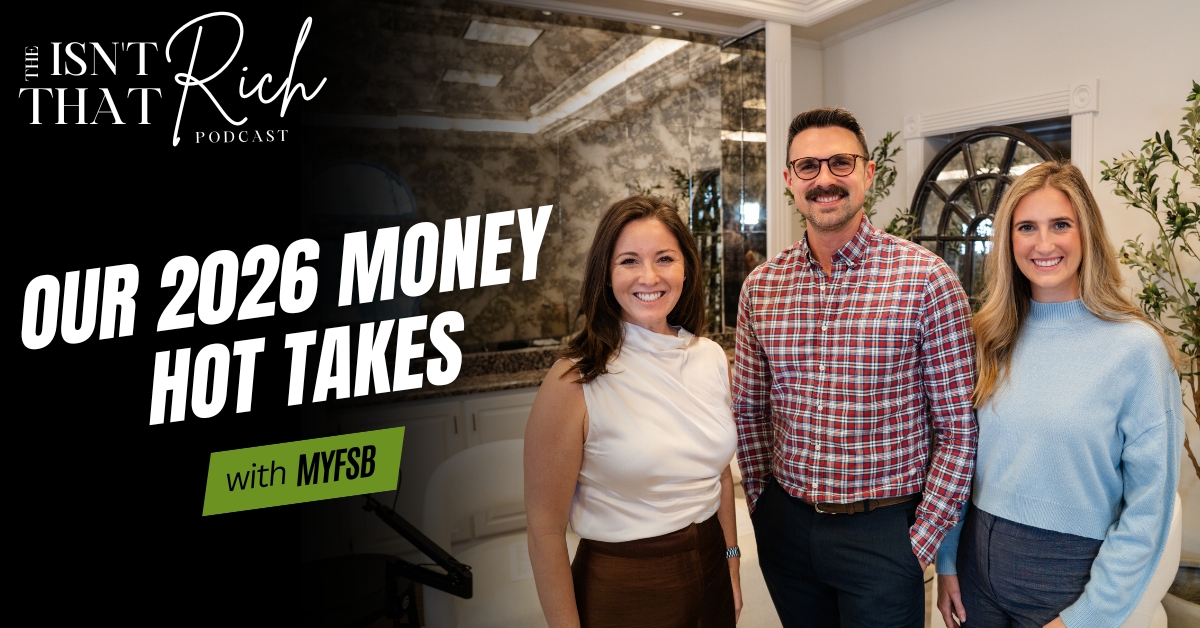
Our 2026 Money Hot Takes
By: Jill Franks + Ashley McVicker + Jared Gravatt
| Apple | Spotify | YouTube |
Every January, there is this little window where everyone is making big plans, cleaning out their junk drawers, and suddenly acting like they are going to become a brand-new person by February.
So naturally… we decided it was the perfect time to share our 2026 hot takes.
Before we jump in: this episode was not a lecture and it was definitely not a crystal ball moment. We are not financial advisors. We are not economists. We are three people who live in the real world, work in banking and marketing, and pay attention to what is shifting around us. We are calling our shots, knowing we could be totally wrong… and fully planning to revisit this at the end of the year.
Our five categories were: social media, our local economy, fraud, AI, and housing. Let us get into it.
Social media is about to get even more real… or people are going to leave it
We started with social media because, honestly, it is part of our everyday work. It affects how we market, how businesses show up, and how people get their information now. And the last couple of years have proven one thing: what worked yesterday is already outdated.
Jared has watched social media shift fast since starting at the bank, and it made us laugh because Ashley and Jill remember when Instagram was basically a curated scrapbook. The grid had to be perfect. Every other tile needed to “match the vibe.” Everything was neutral and clean and aesthetically pleasing.
Now? That whole era is fading. People do not care if your grid is cohesive. They care if you are real. They want the raw stuff. They want the in-the-moment. They want the unpolished.
And one of the funniest examples we brought up is that “de-influencing” is now influencing. You will see someone pop on and say, “Let me de-influence you from buying this…” while still absolutely influencing you. It is just wearing a different outfit.
Jill even shared how she tried to step into the influencer world a little (Amazon influencer program, LTK, the whole thing), and then realized her content was… “very millennial.” Which apparently means “pretty, cohesive, and planned.” Someone literally told her that, and it was one of those moments where you realize the internet has moved on without you.
So our 2026 hot take is basically this:
Social media will either keep shifting toward real human content… or more people will start checking out altogether.
We talked about how AI is going to push that shift even faster, because we are hitting the point where you genuinely cannot tell what is real anymore. And once that line blurs enough, people either get numb to it or they get sick of it.
We even wrote one word down for this prediction: Exodus.
Not everyone will leave, but more people will want to. Because you can scroll for an hour and feel like you consumed nothing. No real value. No real connection. No idea what you even watched. And then you look up and think, “What am I doing with my life?”
We also mentioned something that feels small but is actually huge: platforms are splitting your experience now.
On Facebook, for example, you can literally switch over to a tab that shows only your friends. Because the main feed is so overloaded with suggested content, politics, AI clips, ads, and random noise. It is a different world than what social media started as: a place to keep up with people you actually know.
So where does this go?
Our prediction was that social media becomes more like a customizable search engine where people use it for three main purposes:
-
Entertainment
-
Education
-
Shopping
And the casual “here is my life / here is my family” posting? We think that keeps slowing down.
Our local economy is going to reward the trades (and expose gaps we are not ready for)
This was the part where we had to keep reminding everyone: we are not economists. We are just observing patterns.
One thing that stood out to us recently was a career fair we went to in Hardin County schools. We asked student after student what they were doing after graduation, and we were surprised by how many said:
-
Trade school
-
Construction
-
Straight into the workforce
-
Not a traditional four-year college path
And honestly? We do not blame them.
College is expensive, the job market is changing fast, and a lot of people are looking for careers that pay well without stacking a mountain of debt first.
Then we had another conversation later that day that made us laugh and cringe at the same time, because someone mentioned going into a job that is basically getting automated away right in front of us. Not because they are dumb. It is because so many systems are behind reality. Schools can be teaching paths to success that do not match what the world looks like anymore.
Here is what we do feel confident saying:
So far, AI cannot build a pipe for a toilet.
It cannot wire a house.
It cannot cut your hair.
It cannot do a lot of the hands-on things the real world requires.
And we keep hearing the same thing from all directions: trades are hungry for people. Plumbers. Electricians. Construction. Skilled labor.
So if demand stays high and the workforce does not fill fast enough, what happens?
Trade wages rise.
We already see pieces of this. We gave a real example from our own world: trying to finish a renovation project, and one contractor calling out sick can delay everything because the work depends on a specific skillset. Multiply that across every community where things are being built, repaired, expanded, renovated… and it adds up fast.
But then Jared brought up a “sleeping giant” that really stuck with us, especially in our region:
The boomer aging wave and eldercare pressure
If the largest chunk of the population is reaching an age where they need more medical care, assisted living, or support… are we ready?
Do we have enough workers in those facilities?
Do families have the financial ability to cover that care?
Do people end up having to move away to get proper care?
We talked about how assisted living can have long waitlists, almost like daycare. And that pressure does not feel like it is going away.
Which led us into another prediction that connects to social media, AI, and the economy all at once:
We think people start coming back together.
After years of isolation, after COVID, after the “everybody stay in their own bubble” era, we think we see more community-focused living:
-
multigenerational households
-
families living closer together
-
friends living together as adults
-
“Golden Girls” setups (yes, we said it)
Not because it is trendy, but because it is practical. And honestly… because people need people.
Fraud is going to get weirder, faster, and more convincing
We talk about fraud a lot on the podcast because it is not “out there” anymore. It is constant. And in 2026, we think fraud gets even more creative because criminals always follow convenience.
The example we learned recently (from our IT guy Doug) was something many people have not heard of yet:
“Ghost tapping”
The idea is simple and gross: someone has a card reader, gets close enough to you in a crowd, and tries to tap your card while it is still in your pocket, purse, or wallet.
That is why RFID-blocking wallets exist. And why it might not be a bad idea to turn your cards off temporarily if you know you are going to be in a big crowd.
We also talked about how wild it is that technology often solves one problem and creates another. Tap-to-pay became a huge safety upgrade because it helped reduce skimmers and card swipe fraud… and now people are finding new ways to exploit tap.
And the scary part is how exposed cards are in normal life:
-
sitting on a bar while you close out
-
sticking out of the check presenter at a restaurant
-
being carried away by a server out of your sight
Jill mentioned how in Canada your card often never leaves your sight because they bring the machine to the table. In the U.S., it is still common for someone to walk away with your card and return later, and once you start paying attention to that, it feels weird.
Fraud is not just personal anymore. It is business-level.
Doug also shared something that sounds like a movie: trucking routes being hacked and rerouted so a driver drops cargo at a fraudster warehouse, thinking it is a legitimate stop. They even take the proof-of-delivery photo like normal.
And here is the thing that matters: fraud always has a trickle-down effect.
More theft and rerouted shipments mean higher insurance costs and higher fees, which usually land back on normal people eventually.
The scams that ride the wave of “free money”
We also talked about how any time there is talk of government payments, rebates, relief funds, “you qualify for ___,” scammers swarm it.
Whether it is a tax refund, a rebate, Social Security-related messaging, or anything that sounds like “you are receiving funds,” criminals are going to use it to push links and urgency.
And then there is the most terrifying category:
AI voice scams (“grandparent scams”)
Scammers can use someone’s voice and likeness to call a family member and create panic: “I need money, I’m in trouble.”
Our advice here was blunt because it needs to be:
-
set up a family safe word
-
decide in advance what you will do if you get a scary call
-
slow down, verify, and do not act out of panic
It is sad, but you almost have to assume nothing is real until you confirm it.
We also think security is going to keep tightening. More authentication apps. Less reliance on text codes. More layers.
And we talked about how even that can be tricked if someone is good enough. Fake log-in screens. Fake “authentication” prompts. Things that look real.
Which brings us to what banks are doing.
How banks will respond
We mentioned that banks are already having to build around this. In our executive meeting, we even talked about the idea of hiring a full-time person whose job is fighting fraud nonstop, because fraud has grown beyond what teams can handle “on the side.”
This is not to scare you. It is to say: fraud is not slowing down, so protection cannot slow down either.
AI is going to reorganize everything… and it is going to push people back to real life
By the time we hit our “AI section,” we had already been talking about AI in every category anyway. Because that is the point: AI is not just one trend. It is touching everything.
We talked about the fear that AI wipes out jobs, especially white-collar and creative jobs, and yeah… there is truth in that conversation. Even in media, people have already created podcasts that look and sound like real humans laughing and bantering… and then reveal they are AI.
That is a lot.
But our take was not “AI is going to destroy everything.” Our take was:
AI is going to reorganize work.
And we hope what it does is push humans toward more creative, more human, more community-based experiences.
Ashley made a great point from a marketing perspective: if AI starts taking over the internet content machine, businesses still have to market. They are not going to stop marketing. So they will be pushed toward doing more in-person, community-based marketing:
-
classes
-
events
-
real relationships
-
real faces
-
real staff, real stories
Because people can sense fake. And we already know we hate stock images. So imagine how much people will hate an entire brand that feels like AI-generated noise.
The part people forget: AI requires real-world infrastructure
We also talked about data centers, because AI is not magic floating in the cloud. It is physical infrastructure that takes power and water, and those facilities have to be built somewhere.
Jared shared seeing communities protesting large data centers because of how much energy and water they can consume without giving much back locally. It raised a bigger question:
What happens when farmland, resources, and space are increasingly used for data infrastructure?
That is not a “light” conversation, but it is a real one.
And then Jill and Ashley brought up a prediction that felt very true:
We are going to see a divide.
One group of people doubling down on human community, real connection, and real life. And another group giving in fully, letting AI fill companionship, therapy, advice, and even relationship roles.
That sounds dramatic… but honestly, parts of it are already happening.
And in the middle of all this? We are out here talking about taking pottery classes and learning how to sew. Because the more tech gets intense, the more people crave tangible, human activities.
Housing gets smaller, more shared, and more expensive to keep
We wrapped up with housing because it is always tied to finances, stress, and lifestyle changes.
The 50-year mortgage debate
We argued (in a fun way) about the idea of 50-year mortgages. Jill and Ashley do not think it happens, at least not soon. Jared thinks it could, because debt culture in America keeps finding ways to slap a band-aid on affordability instead of addressing the root issue.
So our official position is: two against one, but we will revisit.
What we do think we will see: smaller new builds
In rural communities, we think smaller new construction becomes more common. Not everyone wants (or needs) a 3 bed / 2 bath anymore.
More people are:
-
not getting married
-
staying single longer
-
downsizing
-
choosing quality over quantity
-
living as empty nesters
So you may see more:
-
2 bed / 2 bath
-
2 bed / 1 bath
-
smaller footprints with nicer finishes
More renting, even in small towns
We also think renting increases. The “American Dream” version of homeownership is getting harder to reach, even for people doing everything right.
And as space gets tight and development patterns shift, we could see more building “up” and more apartment complexes, even in places where that used to feel unusual.
Communal living becomes normal again
This connects back to our economy conversation too: we think more people live together. Families combining households, building on family land, friends living together as adults, multigenerational setups.
Not because everyone suddenly wants to start a commune… but because affordability and community are both pushing in that direction.
Property taxes and insurance pressure
Jill made a point that hit hard: people can get pushed out of homes they have lived in for years because of rising expenses like property taxes and insurance, especially if they are retired and their income is not increasing at the same pace.
That is one of the reasons we think downsizing and renting grow.
Interest rates: we hope down… but not “back to zero”
We all agreed we hope rates come down, but we do not think we are going back to the early 2020 levels. If they drop even a little, we think the next wave is:
-
more people jumping back into the market
-
more refinance talk
-
more pressure on inventory
-
potentially more bidding wars again
The point of hot takes is not to be right, it is to pay attention
We ended this episode basically saying: we might be wrong. Some of this might happen in ways we do not expect. Some of it might not happen at all.
But it is good to think ahead, pay attention, and have your eyes open. Because whether it is fraud, AI, housing, or the job market, most of the stress people feel comes from being caught off guard.
And if there is one theme that kept showing up in every category, it is this:
The more digital things get, the more valuable real life becomes.
Thanks for hanging out with us for our 2026 predictions. We will absolutely be revisiting these at the end of the year to see how many we nailed… and how many we wildly missed.