

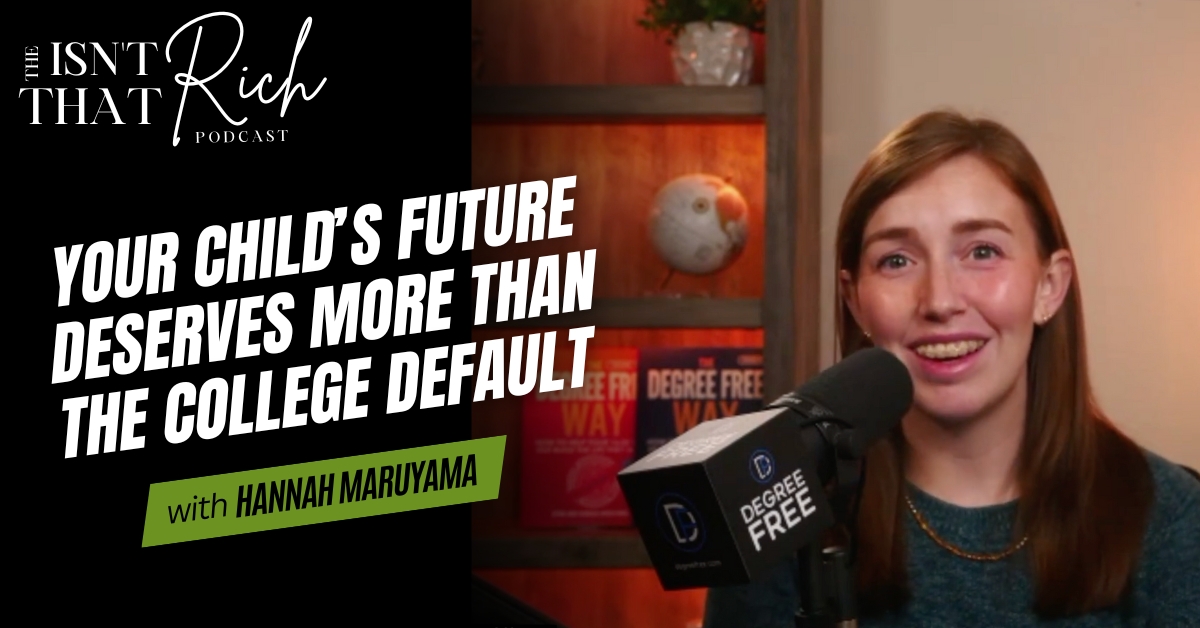
Your Child's Future Deserves More Than the College Default with Hannah Maruyama
By: Jill Franks
| Apple | Spotify | YouTube |
Last fall, our team attended several local high school career fairs. We asked students the simple question: “What are your plans after graduation?” And the answers were almost always the same short list.
A four-year university. A local two-year school. Maybe a trade like construction.
All of those are solid options. The problem was not the options themselves. The problem was how limited the menu seemed to be. A lot of students were not choosing a path because it truly fit them, but because they did not know what else existed. Very few could describe what they wanted their life to look like after school, what kind of work they would actually enjoy, or what opportunities were available beyond what they have seen around them.
That is what led me to Hannah Maruyama, the founder of Degree Free. Hannah’s message is not “college is bad” or “trades are the answer.” It is something much more practical: college and trades should not be the default for everyone. The default should be a thoughtful process that helps a young adult understand themselves first, then choose a career path that fits the life they want to build.
What Hannah shared in our conversation felt like exactly what parents and teens need right now, especially in small communities.
How Degree Free Started: Proof That “Requirements” Aren’t Always Requirements
Hannah’s work started with her own career transition. She is “degree free” herself. Years ago, she pivoted into tech and landed a job that listed an advanced degree as a requirement, even though she did not have one. What made the difference was not a credential. It was getting the right skill set and presenting it clearly.
She was able to do that in about 45 days, then repeat those results for friends and family by going back to first principles: what is the minimum effective dose of skills needed to enter a specific job, and what is the fastest, most strategic way to get them?
Eventually, she and her co-founder (and husband), Ryan, started hearing the same request from adults they coached: “Can you help my kid figure out what to do after high school?”
The response was overwhelming. That became the launch program, designed for young adults ages 16–20. The focus is simple: figure out what you need from work, identify the skills required to enter your target field, and help you land that first strategic job. Hannah emphasized that in many cases, that path does not require buying a college degree.
Why So Many Kids Feel Stuck: “Vocational Creativity” Is Limited Everywhere
One of the most interesting parts of our conversation was how Hannah described the problem as bigger than any one student. Your opportunities feel limited largely because of what you have been exposed to.
Hannah shared that in her own high school experience, she was good at writing. That became her label. And once you get labeled, the path gets narrow fast: “You’re good at English, so you should teach or go into journalism.” Then the funnel pushes you into college because that is “just what you do.”
She also shared how Ryan’s experience was different but still limited. In his household, the options were culturally framed as: doctor, lawyer, or finance. A different short list, but still a short list.
Her point was powerful: kids in big cities and kids in small towns can both grow up with a limited range of career options. Even parents with corporate jobs may not know much about skilled trades that can lead to business ownership, and parents in trades may not be aware of tech careers like network security, systems administration, or cybersecurity. Almost everyone is operating with blind spots, just in different places.
Small Town Reality: When “The Good Jobs” Disappear, What Replaces Them?
In areas like ours, we have an extra layer to the problem. Some communities were built around industries that are not what they used to be. When those jobs fade, the next generation starts believing opportunity must be found somewhere else.
Hannah’s response was not to romanticize staying or shame leaving. She said the first step is to stop asking, “What jobs exist here?” and start asking something more important: “What does my child need from work to build the life they want?”
Because when you get clear on the life requirements, you can work backward into a career strategy that might include staying local, working remotely, learning a trade, or building something of your own.
Start With First Principles: The Four Things Every Teen Needs to Define
Hannah’s framework starts with four core requirements. She brought this up again and again because it is the foundation everything else rests on.
Income: How much money do they need to make to support the life they want?
Location: Where do they want to live and build their life?
Schedule: What kind of hours and flexibility do they want?
Work environment: Not “industry” like animals or healthcare, but the real day-to-day conditions. Desk work or on your feet. Fluorescent lighting all day or outdoors. Quiet focus or constant interaction. Physical demands and sensory demands matter.
Hannah said this works for every kind of young adult, including those with disabilities or medical needs, because it is built around real-life requirements, not generic advice.
And her analogy was perfect: you cannot find something in a store if you do not know what you are looking for. You need a description first.
She also gave a practical tip for parents: if your teen does not know what they want, ask what they do not want. What schedule do you hate? What environment would drain you? What income would be too low? Sometimes “no” is the fastest path to clarity.
The Hidden Cost of College Is Bigger Than Tuition
When people talk about college costs, they usually mean tuition. Hannah broke down why that is only part of the story.
One major issue is uncertainty. Most students do not finish in four years. Many take longer, which increases tuition, living expenses, and the interest that follows. It makes the true cost hard to estimate at the beginning.
Then there is the cost parents and students overlook the most: lost wages. Those years spent in school are years not spent earning, building experience, and building connections.
Hannah also shared two statistics that should stop every family in their tracks:
A large portion of students do not graduate at all, meaning they spend time and money without getting the credential they were told would “open doors.” And even among those who do graduate, only a small portion end up working in their field of study.
Her argument was not that education is bad. It was that buying a degree without a clear reason is an expensive gamble.
The Myth That College Creates Career Connections
One of Hannah’s most blunt points was about networking.
A lot of families assume college automatically creates a professional network. Hannah said that in reality, many professors have not worked in the current industry landscape, and even when they have, it was often long ago or in a limited consulting capacity. That makes it harder for them to connect students to real entry-level opportunities today.
The connections that matter most come from being in rooms with professionals who are actually doing the work now.
That is why she emphasized a strategy that feels simple, but is life-changing: get your teen around working professionals as early as possible. That is where opportunities come from.
“College Delays Clarity” and Makes the Decision More Expensive
One phrase Hannah used that really stuck with me was “college delays clarity.”
A lot of parents use college as a placeholder when their kid is unsure. It feels productive. It feels safe. It feels like you are pushing them forward. But Hannah’s point was that this often just postpones the decision and makes it far more expensive when reality hits.
She also said something that will make some people uncomfortable, but it is worth hearing: some young adults should go to college, but they go too early, for the wrong thing, because they were forced to pick a major before they understood their goals. Meanwhile, they might have been better served by working first, gaining clarity, and then pursuing the exact education needed for the specific career they truly want.
The “Pre-Checked Box” Problem: Why It Feels So Hard to Do Something Different
Hannah described college as a pre-checked box in our culture.
And her message to parents was clear: uncheck it mentally.
She pointed out the obvious truth we rarely say out loud. College is a business, and it is profitable for that box to stay checked. That does not mean it never has value. It means families should treat it like what it is: a major purchase that needs a clear purpose.
She also said one of the most powerful ways to put your child ahead financially is surprisingly simple: do not put them in student loan debt.
She explained that waiting can actually open doors. For example, if a student chooses a work-first path, they might be in a position a few years later to pay cash for education, or pursue education with far less debt. In addition, there is less panic, more clarity, and often a stronger reason for the schooling.
The Degree Free Four-Step Process for Career Planning
Hannah laid out a practical, research-driven process that parents can use at home. It is not “inspiring.” It is strategic. And honestly, that is why it works.
First, define the four requirements: income, location, schedule, and work environment. Do it over time, not like an interrogation. Go for a drive. Break it into smaller conversations.
Second, build a list of jobs that match those requirements. Hannah advised using the internet, not outdated career tools that rely on old occupational databases. Her point was that fast-changing careers often show up late in traditional systems, and schools may be using software that is behind the real market.
Third, narrow to the top three jobs based on interest, strengths, curiosity, and “does this sound cool?” Then do “day in the life” research. Look for real people describing what the job is actually like.
Fourth, identify what is truly required: licenses, certifications, and skills. Check for legal degree requirements. If a degree is not legally required, ask: what certifications, hours, or training pathways are the smartest way to get into an entry-level role?
The theme here is simple: do not pursue credentials until you know exactly why you are pursuing them.
“Find a Master and Shadow Them”: The Confidence Builder Most Teens Need
Hannah encouraged something I wish every teen would do at least once: pick a job that interests you and ask to shadow someone.
Not the parent. The teen.
Write a simple script. Make the call. Ask to come observe, ask questions, see what the work really looks like.
Hannah said most professionals are happy to help when a young person shows genuine curiosity. And she is right. We have seen it ourselves. Sometimes that one call turns into a job offer because it signals maturity, initiative, and real interest.
And that is how confidence gets built. Not by “hoping” a degree works out, but by taking small steps that create real feedback and real wins.
The Five Degree-Free Pathways After High School
To help families stop thinking in extremes, Hannah listed five practical career pathways outside of college. These are not “less than.” They are simply different vehicles.
Get a job (not just any job, but an entry-level role that actually aligns with a long-term plan).
On-the-job training or apprenticeships (not only trades, but also paid training programs in industries like tech, insurance, cybersecurity, and more).
Earn a license or certification (from tech certs to pilot licenses to court reporting to industry-specific credentials).
Build a business (including creatively buying a small local business from an owner ready to retire).
Learn a skill (which often leads into either employment or entrepreneurship).
She also brought up something she called the “silver tsunami,” the wave of small business owners nearing retirement with no clear successor. In many towns, that is not just a challenge. It is an opportunity for young people who can learn, apprentice, and step into ownership.
The Bottom Line: Success Is Your Child Getting What They Want Out of Life
My favorite moment in the conversation was when we reframed success.
Success is not a degree on the wall.
Success is your child having a life that fits them. A career that supports that life. Financial momentum instead of financial anxiety. Options instead of pressure. Clarity instead of confusion.
Hannah ended with something I think we all needed to hear: the future is bright. These kids want good lives. They want homes, families, and meaningful work. Our job as adults is to help them find the right vehicle, not force them into the one that is most socially accepted.
Interested in Degree Free for Your Child?
If this conversation resonated with you and you would like your child to go through the Degree Free program, we would love to support you in that process. We believe giving young adults clarity before making big career and financial decisions can be life-changing.
To get started, visit DegreeFree.com and explore the resources and Launch Program designed for ages 16–20. If you feel it is a good fit for your family, reach out to our marketing team at Farmers State Bank. We will walk you through next steps and how we can help support your child’s participation.
Our goal is simple: to help families in our communities make confident, informed decisions about what comes next, whatever path that may be.