

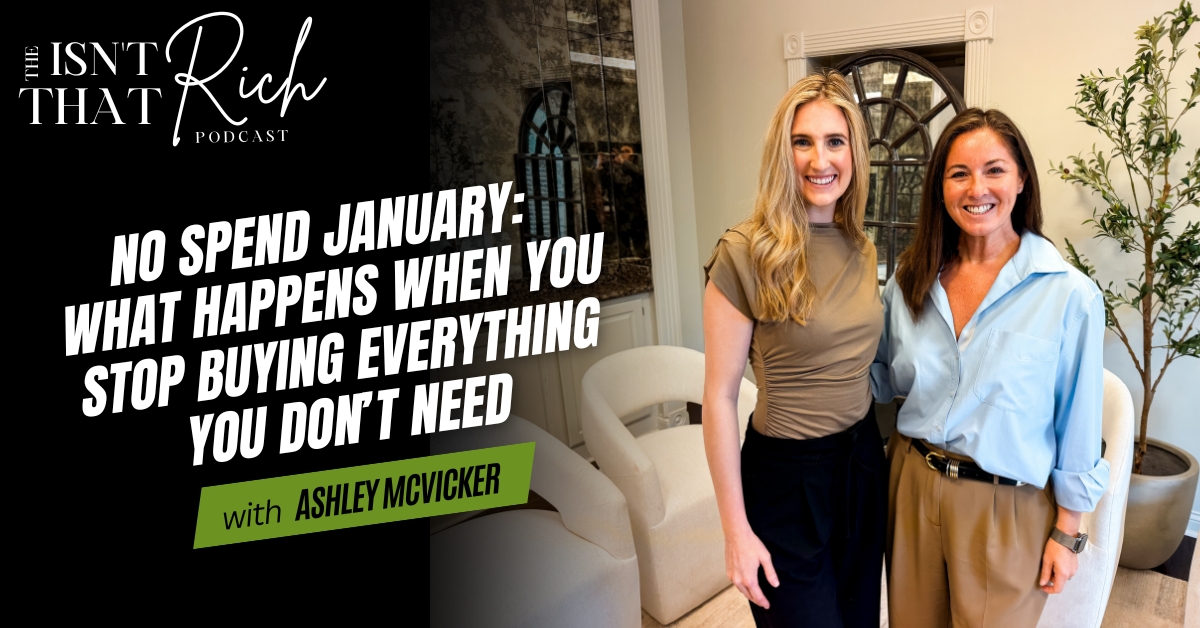
No Spend January: What Happens When You Stop Buying Everything You Don?t Need
By: Jill Franks & Ashley McVicker
| Apple | Spotify | YouTube |
There is something about January that makes people want to become a brand-new person overnight. Suddenly everyone is drinking green juice, organizing their pantry into matching acrylic bins, and declaring that this is the year they become “their best self.” And while all of that sounds lovely in theory, Ashley McVicker had a different idea. Instead of signing up for a complicated resolution she would hate by January 4, she decided to do something simple, practical, and honestly a little eye-opening: a no-spend January on non-essential items.
Not a no-food January. Not a no-pay-your-mortgage January. She is still among the living. This was a reset focused on cutting out the extra spending that sneaks in so easily, especially after the holidays when your credit card has been getting more action than it has any business getting.
What started as a post-Christmas financial breather turned into something much bigger. It became a mindset shift, a reality check, and a surprisingly powerful reminder that a lot of what we buy is not actually improving our lives nearly as much as we think it is.
Why a No-Spend January Made So Much Sense
Ashley loves Christmas. She loves giving gifts, celebrating, making things special, and spending money on people she cares about. No regrets there. But like a lot of us, by the time the holiday dust settled, she could feel that she needed a reset.
The spending itself was not the only issue. It was the way her mindset around money had started to shift.
Ashley has always been a saver. She thinks about money carefully, plans ahead, and usually has a healthy relationship with spending. But somewhere along the way, things started feeling a little too casual. A Target run here. An Amazon order there. A few “this will make my life easier” purchases sprinkled throughout the week. And because those purchases were spread out, they did not always feel like much in the moment.
That is the sneaky part.
One day it is $150 at Target because, apparently, no one in history has ever gone in for toothpaste and left with only toothpaste. The next day it is a few things online. Then maybe another stop at a store. Then another little order. It starts to feel like your money resets every morning like you are living inside a video game and your card got magically reloaded overnight.
Spoiler alert: it did not.
The Credit Card Trap That Feels Responsible Until It Doesn’t
Part of Ashley’s spending shift can probably be traced back to something a lot of financially savvy people do: using a rewards credit card.
Last summer, she got a Chase Sapphire card and had to spend several thousand dollars within a certain time frame to earn the sign-up bonus. And to be fair, it worked. The points were worth it. The rewards were great. The trip she used them for was great. On paper, it was a smart move.
But it also subtly changed how spending felt.
When you are working toward a points goal, spending can start to feel productive. It feels like you are winning. You are getting rewarded. You are hitting a target. And if you are responsible enough to pay the balance off in full every month, it can feel harmless.
That is where this gets interesting.
Ashley was never carrying a balance. She was not racking up interest. She was not in financial trouble. But she started noticing that her credit card total was making her do a mental jump scare every time she checked it. That was new for her. And even though she was paying it off, she did not like how much she was putting on the card.
That matters.
A lot of people assume spending is only a problem if you cannot pay the bill. But sometimes the issue starts earlier than that. Sometimes it starts when your spending no longer lines up with your values, your goals, or the kind of financial peace you want to have.
What Counted as “Essential” and What Didn’t
Ashley’s rules were simple. She cut out non-essential spending for the month of January.
That meant she still paid for food, gas, mortgage, bills, and the necessities of life. If she ran out of face wash, she bought face wash. No one needed a dramatic skincare collapse in the name of discipline.
But the random extras? The recreational shopping? The impulsive little purchases that feel small until they become a whole personality trait? Those were out.
No wandering Target just because it sounded fun. No buying random things online because they were only twelve dollars. No adding to the clutter pile disguised as self-care, convenience, or “just a little treat.”
And honestly, that is where most of us would probably feel the sting.
Because the problem is rarely our mortgage payment. It is the tiny leaks. The little extras. The random Amazon items that arrive in a box large enough to hold a Labrador retriever only to reveal a single plastic container organizer you absolutely did not need.
What She Learned in the First Few Days
The very first day of the challenge, Ashley had one of her biggest realizations.
She shops when she is bored.
Not in a dramatic, headline-worthy way. In a normal, everyday, this-is-how-modern-life-works way. A day off rolls around, you have some time to kill, and your brain goes, “Should we go somewhere? Should we browse? Should we just look?”
And “just looking” is how half of America ended up with seventeen throw pillows and a closet full of things with tags still on them.
Ashley realized that shopping had become an activity. Something to do. A way to fill time. A source of entertainment. And once she noticed that, she started noticing even more. She realized she was more influenced to spend than she thought. She realized she shopped more often than she gave herself credit for. She realized the habit was deeper than she had assumed.
That kind of awareness is worth a lot.
Because once you can see the pattern, you can do something about it.
The “Shop Noise” Started to Quiet Down
One of the most interesting things Ashley shared was how the challenge changed the mental chatter around spending.
People often talk about “food noise” when they clean up their diet. That constant internal dialogue about what to eat, what to crave, what to grab, what sounds good. Ashley said she experienced something similar, except with shopping.
Call it shop noise. Call it consumer noise. Call it the modern condition.
At first, the urge was definitely there. She found herself seeing things and immediately thinking, I could buy that. I want that. I should get that. Pinterest ads were doing what Pinterest ads do best, which is convincing perfectly rational women that a plastic drawer divider might actually be the key to peace, order, and personal transformation.
But then something changed.
The noise got quieter.
The urge settled down. The constant feeling that she needed something new started to lose its grip. She got into a groove. Not spending became the habit. And instead of feeling deprived, she started feeling relieved.
That is a big deal, because it proves that so much of spending is momentum. When you are in the habit of buying, you keep buying. When you break the cycle, you start to realize how much of that urge was never really about need in the first place.
Most of What We Buy Is Not as Essential as We Make It Sound
This is where the conversation gets really honest.
Ashley talked about all the categories where her money tends to go: beauty products, home goods, random Amazon finds, miscellaneous little items that somehow add up to real money. Nothing unusual. Nothing crazy. Just the everyday consumer habits so many people have.
But once she stopped spending, she became hyper-aware of how much overconsumption is baked into normal life.
Lip gloss is a perfect example. A tube can last forever, yet somehow we always think buying another one is reasonable because it is at that sweet little price point where it does not feel like a big decision. Same with lotion, candles, supplements, shower gel, and all the other products that multiply in our homes like they are paying rent.
Why do we need six half-used bottles of anything?
Why are there candles burned halfway down all over the house like some sort of wax graveyard?
Why do we keep buying new products before using up the old ones?
Because buying the new thing feels good. It feels fresh. It feels exciting. It feels like possibility. But in reality, it often just becomes more stuff to manage, more clutter to store, and more money quietly disappearing.
Women Are Marketed to Constantly, and It Adds Up Fast
Ashley also connected this experience to something a lot of women know but do not always name out loud: the pressure to keep buying is relentless.
Beauty products. Makeup. Hair. Nails. Skincare. Clothing. Trends. Seasonal refreshes. New “must-haves.” Better versions of things you already own. The messaging never really stops. There is always something newer, cuter, cleaner, prettier, more effective, more luxurious, or more “you.”
And when everyone around you is participating in that cycle, it can start to feel normal. Even necessary.
Ashley had been reading Rich Girl Nation during this time, and one idea from the book really stuck with her: the idea that women are often caught in a kind of hamster wheel, spending money to maintain a lifestyle that may look polished on the outside but quietly eats away at what they could be saving for the future.
That does not mean women should never buy makeup or enjoy nice things. It means it is worth asking the question: is this purchase actually serving me, or am I just participating in a cycle I have been trained to see as normal?
That is a much more interesting question than, “Should I treat myself?”
Because sometimes the real treat is keeping your money.
The Credit Card Difference Was Bigger Than She Expected
One of the most tangible results of Ashley’s challenge was what happened to her credit card bill.
When she checked it after her no-spend month, she was shocked. It was hundreds of dollars lower.
Not twenty dollars lower. Not “oh nice, that helped a little” lower.
Hundreds.
And that is the part that should make all of us pause.
Because if cutting out non-essential spending for one month creates that much breathing room, then the issue for a lot of people is not necessarily income. It is the steady stream of spending that feels harmless because it is broken into small, forgettable pieces.
Ashley did not even go into the month with a specific goal for what that saved money would do. She just wanted a buffer. A reset. Some margin.
But seeing how much she kept by simply not spending it opened her eyes to what is actually possible. More investing. More saving. More flexibility. More room to make intentional choices instead of reactive ones.
That is powerful.
Living Below Your Means Is Still One of the Biggest Financial Power Moves
Toward the end of the conversation, Ashley brought up something people do not talk about enough: lifestyle creep.
This is what happens when your income goes up and your spending quietly rises right along with it. A raise turns into upgraded habits. A bonus turns into shopping. More income turns into more lifestyle instead of more security.
And the hard truth is that a lot of people never really feel ahead because every time they make more, they spend more.
Ashley’s takeaway was simple and solid: live below your means.
That does not mean living miserably. It does not mean never buying anything fun. It does not mean turning into a financial robot who gets excited about denying yourself hand soap that smells nice.
It means not automatically spending everything that comes in. It means creating a little space between what you earn and what you consume. It means understanding that every extra dollar does not have to be assigned to some new want just because it showed up.
That space is where peace lives.
That space is where savings grow.
That space is where options come from.
If You Want Better Clothes, Better Makeup, Better Anything, Buy Less More Intentionally
One of the smartest things Ashley said was that the challenge changed the way she thinks about buying. She did not walk away deciding she should never shop again. She walked away with a better filter.
Instead of constantly buying little things that do not matter, she wants to buy fewer things that are actually useful, wanted, or higher quality.
That is such a healthier approach than swinging between two extremes. You do not need to become a minimalist monk. You also do not need to keep treating every random find like it is a life event.
The goal is to be more deliberate.
Use what you already have. Wear what is already in your closet. Burn the candle all the way down. Finish the lotion. Empty the lip gloss. Sell what you are not using. Clear out what no longer fits your life. Then, when you do buy something, let it be something you actually want and will actually use.
That is not deprivation. That is discernment.
What This Challenge Really Proved
Ashley started January thinking she was doing a small financial reset after Christmas.
What she actually uncovered was a whole chain of habits, impulses, marketing influences, and mental patterns she had not fully noticed before. She proved to herself that she did not need as much as she thought. She saw how quickly consumer noise can fade when you stop feeding it. She realized that a lot of spending is emotional, habitual, and automatic. And she learned that even one month of intentional restraint can create real financial breathing room.
Maybe the biggest takeaway of all is this: saving money is not always about making more. A lot of times, it is about finally seeing where it is already going.
If you constantly feel like there is never enough, it may be worth looking at your spending with fresh eyes before assuming the problem is your paycheck. You might be surprised by how much money is being swallowed by the little things. The Amazon things. The Target things. The beauty things. The home things. The “just because” things.
Those little things have a way of becoming very big things.
A Challenge Worth Trying
If you have been feeling a little too casual with your spending lately, consider this your sign.
Try a no-spend month on non-essentials. Or a no-spend week. Or a no-spend quarter reset. Make your own rules. Keep the necessities. Cut the fluff. Notice what comes up. Notice what you miss. Notice what gets quieter. Notice how often the urge to buy passes if you simply let it.
You may save money, yes.
But more importantly, you may get your brain back.
And these days, that might be worth even more than the money.