

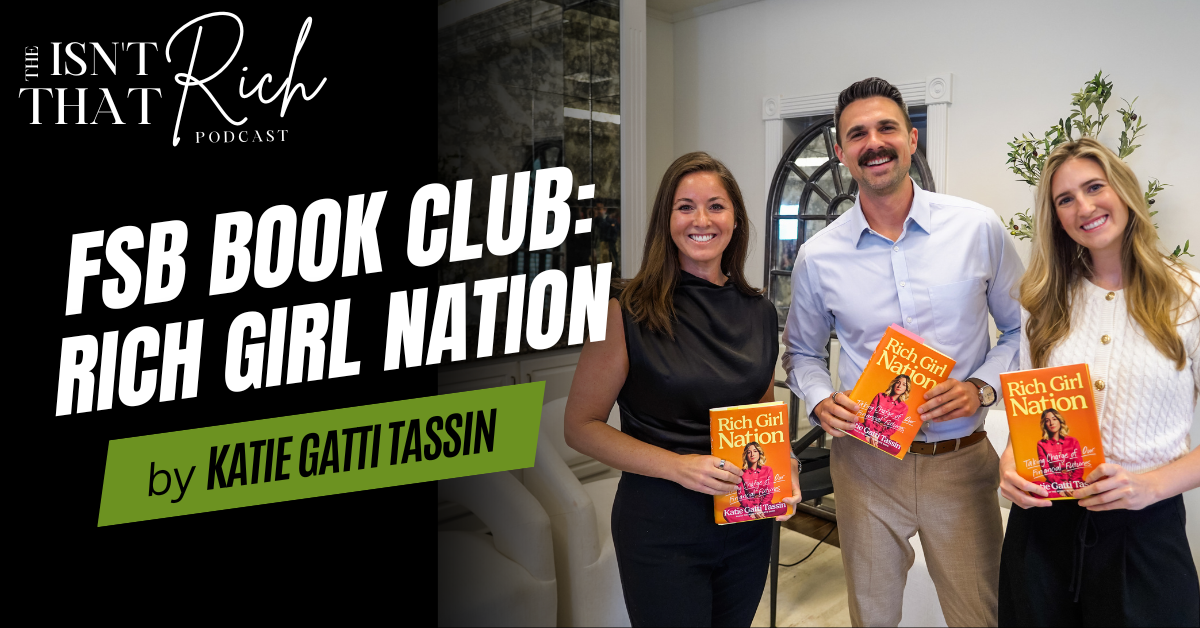
FSB Book Club: Rich Girl Nation
By: Jill Franks, Ashley McVicker, & Jared Gravatt
| Spotify | Apple | YouTube |
We kicked off something new this year, and honestly… we’re a little obsessed with it already. We started a book club!
Because here’s the thing. We talk about money all the time, but we don’t know everything. And instead of pretending we do, we thought—what if we just learned alongside you? What if we actually read the books, had the conversations, and shared what stood out in real time?
So our first book of the year was Rich Girl Nation by Katie Gatti Tassin… and it did not disappoint.
This wasn’t one of those books you read and forget about. It challenged us. It called things out that we don’t always talk about. And it made us take a hard look at some of our own habits.
The “Hot Girl Hamster Wheel” (And Why It’s So Real)
Let’s just start here, because this one hit.
The book talks about something called the “hot girl hamster wheel,” which is basically this cycle women get put on where we’re constantly spending money to maintain our appearance. Hair, nails, makeup, skincare, clothes, fitness… it adds up fast.
And it’s not by accident. It’s marketing. It’s culture. It’s expectations.
The stat that got us was this: the average woman spends about $3,756 a year on beauty, compared to $2,928 for men.
At first, you think okay, that’s not that crazy. But then you zoom out.
What if that extra money was invested instead?
That’s where it gets uncomfortable… because over time, that gap turns into a really big number.
But here’s where we had to be honest with ourselves. It’s not as simple as “just stop spending.” Because the reality is, there are situations where how you present yourself matters. We work in a professional environment. People trust us with their money. Appearance does play a role in that.
So the takeaway for us wasn’t to jump off the hamster wheel completely.
It was to slow it down.
Be intentional. Know what you’re spending and why. And make sure it’s not coming at the cost of your future.
What If the Answer Isn’t Spending Less… But Earning More?
This part of the book felt different in the best way.
Because instead of only talking about saving money, it talked about earning more money.
And no one really teaches you how to do that.
No one teaches you how to ask for a raise. How to position yourself as valuable. How to advocate for yourself without feeling uncomfortable.
One of the biggest takeaways was how you show up at work.
Are you the person who brings problems?
Or are you the person who brings solutions… or better yet, solves the problem and then communicates what you did?
That’s where value is created.
Another thing we loved was the idea of “socializing your wins.” Not in a braggy way, but in a way that lets people actually see the work you’re doing. Because the truth is, putting your head down and working hard doesn’t always get noticed the way we think it will.
And when it comes to negotiating, whether it’s salary, time off, or flexibility, we kept coming back to this simple truth.
The worst they can say is no.
But if you don’t ask, the answer is always no.
The Wake-Up Call: Your Savings Rate Actually Matters
This chapter might have been the one that changed the way we think the most.
Because “save your money” is something we’ve all heard before… but no one really explains what that actually means.
This book does.
It introduces the idea of your savings rate, which is just the percentage of your income that you’re putting toward your future. That includes your 401k, savings accounts, investments, all of it.
And once you see that number, it changes things.
Because now it’s not vague anymore. It’s measurable.
But the real shift came with this idea of working backwards.
Instead of randomly saving and hoping it’s enough, you start with your end goal. What do you want your life to look like in retirement? Then you reverse engineer what it takes to get there.
That’s a completely different mindset.
It also introduced the 4% rule, which is the idea that in retirement, you can withdraw about 4% of your investments each year and still allow your money to keep growing.
So instead of thinking about one big lump sum, you start thinking in terms of income.
What do you want your life to cost?
That number becomes your target.
And what really stood out to us is how small changes now can make a big difference later. Even increasing your savings rate by a few percentage points can shave years off how long you have to work.
The Conversations No One Wants to Have (But Should)
This might have been the most important part of the book.
Because it talked about money in relationships… and how often those conversations just don’t happen.
Not because they shouldn’t, but because they’re uncomfortable.
But instead of jumping straight into “how much debt do you have,” the book suggests starting with lifestyle questions.
Where do you want to live?
How often do you want to travel?
Do you like eating out or cooking at home?
What do you want life to feel like day to day?
Because those answers tell you everything about how someone handles money.
And the truth is, financial misalignment is one of the biggest causes of stress in relationships. Not necessarily because there isn’t enough money, but because expectations were never communicated.
Avoiding the conversation doesn’t protect you. It just delays it.
So, What Did We Take Away?
If we had to sum it up, it would be this.
Your money is going somewhere, whether you’re paying attention to it or not.
So you might as well be intentional.
You don’t have to give up everything you enjoy. You don’t have to be perfect. But understanding where your money is going, how you’re earning it, and what it’s working toward… that’s where the power is.
And that’s what we loved about this book.
It didn’t just give information. It shifted perspective.
If you haven’t read Rich Girl Nation yet, we definitely recommend adding it to your list. And if you want to follow along with our book club this year, we’ve got more coming your way.