

What If You Were Unreasonably Hospitable
By: Ashley McVicker, Jared Gravatt, and Jill Franks
| Apple | Spotify | YouTube |
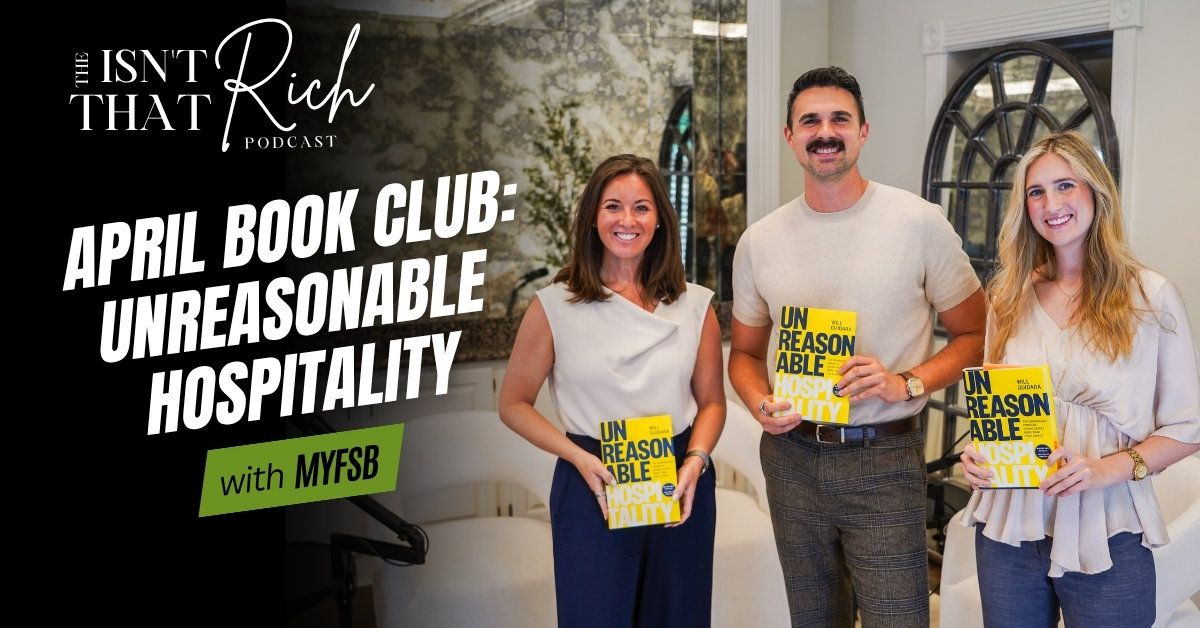
When was the last time a business truly wowed you? Not just did their job, but genuinely went above and beyond in a way you'll never forget? That's the question at the heart of this month's Isn't That Rich Book Club pick, Unreasonable Hospitality by Will Guidara, the restaurateur who transformed Eleven Madison Park from a 50th-place also-ran into the best restaurant in the world.
Spoiler: the secret wasn't perfection. It was making people feel something.
From 50th to First Without Chasing Perfection
The book kicks off with Guidara and his team at a restaurant awards ceremony, walking away ranked 50th in the world. On paper, that sounds crushing but think about it. 50th out of every restaurant on the planet? That's remarkable. They didn't see it that way at first, though. And that tension between "technically excellent" and "genuinely unforgettable" is what the whole book is really wrestling with.
The big mindset shift? Striving for perfection will only get you so far. Customers don't just want an error-free meal or a flawlessly processed transaction. They want to feel something. They want to leave and think, "I have to tell someone about this."
"It's not necessarily about what you're doing and what your job is, but it is about how you make people feel. That's everything."- Jared Gravatt
And once Guidara's team made that mental shift from perfection-obsessed to experience-obsessed, everything changed. The restaurant went on to claim the title of best in the world. Not by firing up the kitchen to ever-higher temperatures of culinary exactness, but by pouring energy into the human moments that happen around the food.
The Hot Dog That Started a Revolution
This was unanimously the favorite story from the book and honestly, it's hard to top. Here's the scene: Guidara overhears a couple at his Michelin-starred restaurant mention, almost in passing, that their trip to New York had been wonderful except for one small thing...they never got to try a real New York street hot dog.
What does he do? He runs out the door, down the street, buys a hot dog, brings it back to the kitchen, and the chefs dress it up and present it as a course. The couple was completely floored.
The "Legend" Concept
Guidara called experiences like this "legends", moments so unexpected and personal that they become stories customers tell forever. He liked the idea so much that he actually hired two people whose entire job was to listen to guests and create a legend for as many of them as possible.
Not for every single table, that would be impossible and a little overwhelming. But for as many as they could, they found a way to hear what was quietly on someone's heart and made it real. That's the standard they were chasing.
What struck Jill, Jared, and Ashley about this wasn't just the romance of the story, it was how practical it actually is. You don't need a Michelin-star budget or a fancy kitchen to do this. You just need to genuinely listen to people and have the freedom to act on what you hear.
The Bar Is Low and That's Actually Good News
Here's something that came up multiple times in the episode and it's worth sitting with: the general state of customer service in America right now is not exactly soaring. Self-checkout at the gas station. Nobody looking up from their phone. Interactions that feel transactional at best and deflating at worst.
"I actually think it's easier to exceed standards nowadays because people are so bottom of the barrel. The bar is set a little low, and we have a lot of opportunity."— Ashley McVicker
That might sound pessimistic but flip it around: it means the bar for "wow" is genuinely not that high right now. If you make eye contact, use someone's name, remember what they told you last time, or just act like you're genuinely glad they walked in, you're already doing something memorable.
Technology has made it easier than ever to automate away the human parts of service. The businesses willing to lean into those human moments right now have an enormous opportunity to stand out. Think about the waitress at their local haunt who already has everyone's order memorized before they've even sat down, or even the Wendy's drive-through attendant who knows Jared's usual and gently corrects him when he tries to change it. That kind of attentiveness? People notice. People come back. People tell their friends.
One Restaurant, One Team. No Front vs. Back
One of the recurring tensions in the book is the divide between the front of the house and the back of the house. The kitchen cares about perfect plating; the dining room cares about making guests feel at ease. Neither is wrong but if they're working against each other, the guest experience suffers.
Guidara's solution was to get everyone operating under the same clearly articulated mission and set of core values. When the whole team understands what you're collectively chasing, you can all make real-time judgment calls that serve that mission, without needing three approvals from above.
Principle from the Book
The way you do one thing is the way you do everything. Whether it's how you plate a dish or how you greet someone at the door, it's all part of the same story you're telling about who you are.
This resonated deeply for the team at Farmer State Bank. Customer-facing employees and the operations team behind the scenes have inherently different vantage points. But they're one bank. One failure isn't an "ops problem" or a "teller problem", it's a shared opportunity to do better together. Getting that shared ownership embedded into culture is some of the hardest and most important work any organization can do.
The Danger of Doing Too Much (Yes, Really)
Here's the counterintuitive lesson that was almost as memorable as the hot dog: you can absolutely go too far. Guidara recounts a dinner at a Michelin-starred restaurant where the staff was so dedicated to being perfectly attentive that the couple was interrupted fourteen times throughout their meal, once for every new set of silverware.
At a certain point, the pursuit of perfection became its own form of disruption. They scaled back their own menu from eleven courses to four. Not because they stopped caring, but because they realized the customer's actual experience of pleasure and connection was getting buried under all the meticulous fussing.
Too many policies, too little oxygen
Jared made a great point that this applies just as much to corporate policy as it does to silverware. When businesses pile on rule after rule and procedure after procedure without asking whether each one is actually getting them closer to their goal, things start to die, culture, creativity, and customer experience right along with them.
Not every policy deserves to live forever. If it's not producing good fruit, it might be time to take it off the menu.
So What Does This Look Like at a Bank?
This is where the conversation really caught fire. The hosts kept circling back to: how do we actually do this? Not the hot dog specifically, but the spirit of it. Here's what they landed on:
Applications for Farmer State Bank
- Give frontline staff a small discretionary budget to act on the spot, no approvals needed. When a teller hears someone mention something meaningful, they can do something about it right then.
- Hyper-personalize gifts instead of defaulting to the same thing for everyone. A thoughtful, specific gesture will always outperform a generous but generic one.
- Learn and use customers' names every time. There's something quietly powerful about walking into a place and being greeted by name. It says: you belong here.
- Document the details. If you know a customer prefers a certain way of doing things, note it. The next person who helps them benefits from that institutional memory.
- Greet customers the way you'd greet a friend arriving at your home. Not a script but a genuine, warm human acknowledgment that you're glad they're here.
And perhaps most importantly: remember that every single person who walks through the door is carrying something you can't see. You might be the only person they've really talked to today. That's a real responsibility and a real opportunity.
Stories from the Hosts' Own Lives
The best part of this episode was how naturally these principles mapped onto memories the hosts already had, proof that unreasonable hospitality has always been around. We just don't always name it.
The Lululemon Headband
Jill recalled working at Lululemon during the era when the brand's athletic headbands were the hottest thing going for teenage girls. A little girl came in, clearly having saved every dollar of her allowance for weeks to afford one $25 headband. Jill, empowered by a discretionary budget the company gave its staff, handed it to her with a simple: "This one's on us."
The little girl started crying. Jill will never forget it. Neither, you can bet, will that little girl.
The Huck's Fried Chicken Moment
A year earlier, radio personality Kent Zimmer had mentioned offhandedly to Jared and Ashley that he loved Huck's fried chicken. Cut to a year later: they show up at the radio station with a whole bucket of it. After calling four or five different Huck's locations trying to find one that sold real fried chicken (dedication!), they finally pulled it off.
Kent got on air and talked about it. The whole studio was buzzing. A $12 bucket of gas station fried chicken became the kind of story that travels, and that's the point. It wasn't expensive. It was personal. And he knew that they had genuinely listened to something he said and held onto it for an entire year.
Road Trip Snacks at 3 AM
Jill also shared a memory from a work trip she had to make at three in the morning. Her boss had arranged everything, the van, the logistics, etc, and when Jill got in, her favorite road trip snacks and a drink were already waiting on the seat. It cost next to nothing. It meant everything.
The 5% That Matters More Than the 95%
Guidara talks about how his restaurant budgets roughly 95% of everything they have toward running the operation — food, staff, rent, all of it. But 5% is reserved purely for creating unreasonable moments for guests. No strings, no ROI calculation. Just: how do we create something priceless?
"The value of a gift is dependent upon what it's worth to the receiver."— Will Guidara, quoted by Jared Gravatt
This is worth sitting with. You can spend a lot of money on a gift that lands with a thud because it doesn't mean anything to the person. Or you can remember that someone mentioned they liked a specific gas station's fried chicken, and spend twelve dollars on something they'll talk about on the radio.
It's not the price tag. It's the proof that you were paying attention.
The $1,000 Candy Bar Story
In a fun moment from the book, someone asked what would make the restaurant better, and they joked about needing a million dollars. Behind the scenes, the team found a thousand-dollar chocolate bar in their gift stash and slipped it under the person's seat. Absurd? Yes. Unforgettable? Completely.
Key Takeaways
If you take nothing else from this episode, or from the book itself, here's what the hosts want you to walk away with:
-
You have a choice every single day.
You can clock in, do the job, clock out. Or you can decide that every interaction is an opportunity to make someone's day meaningfully better. That choice belongs entirely to you.
-
Listen more than you talk.
The hot dog moment, the fried chicken, the headband — all of it started with someone paying close enough attention to notice what mattered to another person. Real listening is the foundation of everything.
-
Impactful doesn't mean expensive.
Hospitality isn't a budget problem. It's an attention problem. The most memorable things you can do for people are almost never the most expensive.
-
Don't strangle your team with policy.
If a rule isn't producing good results, it's worth questioning. Give your people the freedom, and the resources, to do something meaningful in the moment.
-
This applies at home too.
Get up and greet the people you love when they walk through the door. Remember what they mentioned last week. Show up in the small moments. Hospitality isn't just a business strategy, it's a way of living.