

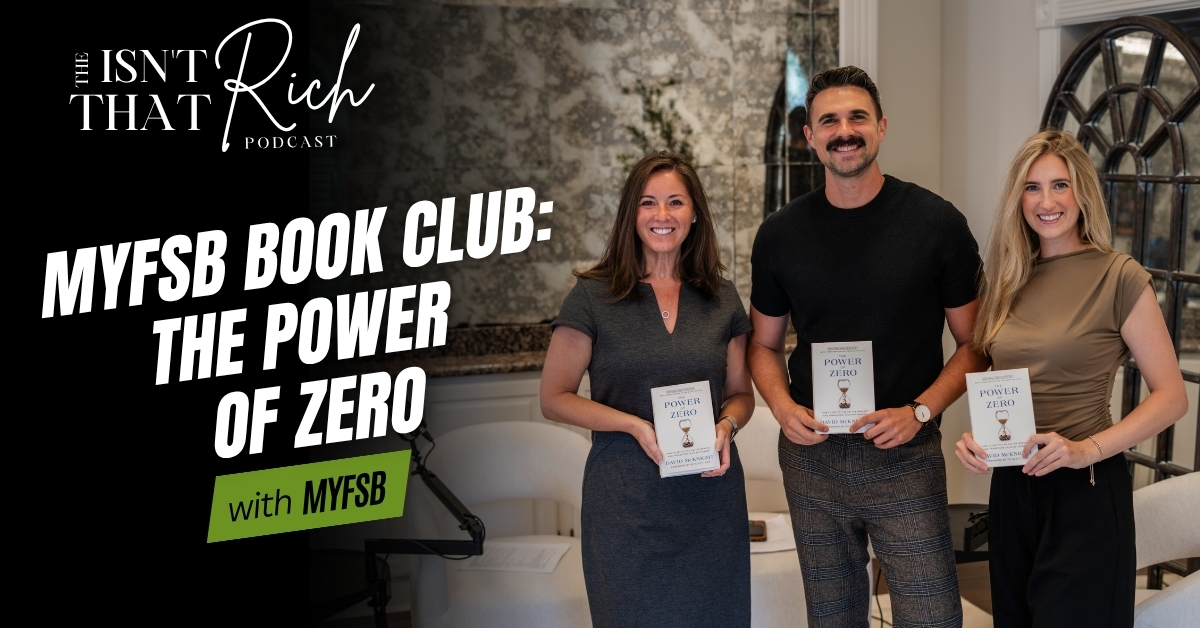
MyFSB Book Club: The Power of Zero
By: Ashley McVicker, Jared Gravatt, and Jill Franks
| Apple | Spotify | YouTube |
Taxes. Nobody loves talking about them, and most of us would rather not think about them until we absolutely have to. But what if not thinking about them right now is one of the most expensive mistakes you could make for your future? This month's book club pick, "The Power of Zero" by David McKnight, cracked open a conversation we didn't know we needed to have, and it changed the way we think about retirement savings entirely. Fair warning: it is a technical read. But once it clicks, it really clicks. And if you stick with us through this blog, we think it will click for you too.
The Gathering Storm: Why Taxes Probably Aren't Going Down
The book opens with a chapter called "The Gathering Storm," and it sets a tone that is equal parts eye-opening and a little unsettling. The United States national debt is now somewhere in the neighborhood of $39 trillion, which is actually more than the entire U.S. economy produces. Every year, we pay over $1 trillion in interest just to service that debt, and where does that money come from? Our taxes.
Here's what made us think: we all tend to complain that taxes are too high. But historically speaking, today's tax rates are actually quite low. In the 1930s, any dollar earned over $200,000 was taxed at around 90%. There was almost no incentive to earn beyond that threshold. By comparison, the brackets we operate in today look relatively tame.
McKnight's argument is that given the national debt, the obligations tied to Social Security, Medicaid, and Medicare, and the shrinking options for borrowing from other countries, the most likely direction for taxes to go in the future is up. Not down. The question he poses is a good one: if most of your retirement savings are sitting in traditional IRAs or 401(k)s, do you actually know how much of that money is yours? Because the IRS is going to have something to say about it when you start pulling it out.
That reframe alone made this book worth reading.
The Three Buckets: A New Way to Think About Your Money
The heart of this book is built around three buckets, and once you understand them, it becomes a really useful mental model for organizing your finances.
The Taxable Bucket
This is your checking account, savings account, CDs, brokerage accounts, mutual funds held outside of retirement accounts, and individual stocks. You pay taxes on the interest, dividends, and capital gains generated in these accounts as you go. McKnight's point is not that you shouldn't have money here. You absolutely should. You need liquidity. You need an emergency fund. You need to be able to pay your rent and your bills without waiting until you're 59 and a half to access your money. But you also don't want this bucket overflowing, because every dollar sitting in a low-yield savings account is a dollar that could be working harder for you elsewhere, and the tax drag on growth is real.
The Tax-Deferred Bucket
This is the one most of us have been told is the gold standard. Your 401(k), your traditional IRA, your SEP IRA, your SIMPLE IRA, pre-tax employer match, and pensions all live here. The idea is that you put money in now, it grows, and you pay taxes later. Sounds great in theory. But McKnight challenges the assumption that "later" will be cheaper.
Think about it this way: when you're younger, you likely have more deductions available to you. A mortgage. Kids. Charitable contributions. Those deductions lower your taxable income. When you're retired, many of those write-offs are gone. You're not paying mortgage interest anymore. Your kids are grown. And while you might be volunteering at charities, the government doesn't give you a deduction for your time. You could very easily find yourself in a higher tax bracket than you expected in retirement.
One of us pointed out something that McKnight really hammers home: your tax-deferred accounts are not entirely yours. The IRS is a silent partner in every dollar sitting there, and they get to decide how much they take when you withdraw. That's not a comfortable feeling once you really sit with it.
There's also the issue of Required Minimum Distributions, or RMDs. Once you hit a certain age (currently 72), the government can actually force you to take money out of these accounts whether you want to or not. That forced withdrawal can push you into a higher tax bracket, make more of your Social Security income taxable, and even increase your Medicare premiums. You don't get to control the timing. They do.
McKnight compares growing a tax-deferred account to being in a business partnership. If your partner owns a stake today and you want to buy them out, you pay today's price. But if that business grows significantly and you wait 20 or 30 years to buy them out, you're paying a much higher price. Paying your tax partnership out now while rates are lower is the whole argument.
The Tax-Free Bucket
This is where McKnight wants you to build your wealth, and where a lot of us realized we should be shifting our focus. Accounts in this bucket include the Roth IRA, the Roth 401(k), Roth conversions from traditional accounts, and properly structured life insurance strategies. The money you put into these accounts has already been taxed, so when you pull it out in retirement, it comes out completely tax-free. If tax rates double between now and when you retire, zero times two is still zero. That's the whole point.
One of us had a lightbulb moment reading this: if you plan to need $100,000 per year in retirement and your savings are all in tax-deferred accounts, you actually have to withdraw closer to $125,000 to cover the taxes. You're not just taking what you need. You're taking extra to hand over to the government. That is a detail most people never think through.
The Social Security Surprise
Here's something that stopped us in our tracks. Most people assume that the Social Security money they've been paying into their entire working lives will come back to them in full when they retire. That is not necessarily true.
If you're a single person in retirement pulling in less than $25,000 per year in total income, your Social Security benefit is not taxed. But if your income in retirement falls between $25,000 and $34,000, up to 50% of your Social Security benefit is taxable. And if your income exceeds $34,000, up to 85% of your Social Security benefit could be taxed at your applicable rate. For married filers, the thresholds are higher but the same principle applies.
So the statement on your Social Security report that says "you will receive X amount per month" is not necessarily what you will keep. This is one of the reasons the tax-free bucket matters so much. If you can structure your retirement income so that less of it is counted as taxable income, you protect more of your Social Security benefit.
The LIRP: The Confusing But Interesting One
The book also introduces something called a Life Insurance Retirement Plan, or LIRP. We will be honest with you: this was the most difficult section of the book. A LIRP is a specially structured life insurance policy that can serve as an additional tax-free income stream in retirement. The benefits McKnight outlines include no contribution limits, no income limits, no required minimum distributions, and no legislative risk since the government cannot force you to stop contributing to it the way they could theoretically change the rules on a Roth IRA.
He uses a clever analogy to explain the fees. Think of an ATM machine. Whether you withdraw $20 or $200, the fee is $2.50. It never changes. A LIRP can work similarly, with a predictable, fixed fee structure rather than a percentage that scales with your account balance.
The biggest practical benefit of a LIRP, though, comes in the form of long-term care. If you or your spouse ends up needing nursing home care or extended medical assistance later in life, the government requires you to spend down most of your assets before they will step in to help. A LIRP can provide a vehicle to borrow against for those expenses, and because it is structured as a loan rather than a withdrawal, there are no income taxes on it.
That said, a LIRP is not necessarily the starting point. McKnight is clear that the Roth IRA and Roth 401(k) come first. The LIRP is best understood as a supplemental tool, particularly for higher earners who exceed the Roth IRA income limits or who want to build additional tax-free income streams beyond what a Roth allows. Our advice here mirrors McKnight's: talk to a financial advisor who really understands this product before making any moves, because the structure has to be set up correctly or it can create more problems than it solves.
The Tax Sale of a Lifetime
This chapter is one of the most urgent in the book. McKnight argues that right now, we are living through a historic tax sale. Current tax brackets are among the lowest they have been in decades. And if rates go up even 1% from where they are today, the money you continue pouring into tax-deferred accounts will cost you significantly more when you finally pay the tax bill in retirement.
For reference, here is where the 2026 single-filer tax brackets currently stand: 10% on income up to $11,925; 12% on income from $11,925 to $48,475; 22% from $48,475 to $103,350; 24% from $103,350 to $197,300; 32% from $197,300 to $250,525; 35% from $250,525 to $626,350; and 37% on income above $626,350. These numbers will shift with inflation over time, but the percentages give you a baseline to work with. You can always find the most current brackets at IRS.gov.
The takeaway is not to convert everything overnight. It is to move money intentionally over time. Start by taking the employer match on your 401(k) because that is still free money. Then consider directing additional contributions toward a Roth 401(k) or Roth IRA rather than a traditional account. Over time, you may want to explore converting portions of your traditional IRA into a Roth, paying the taxes now at today's rates rather than waiting for the bill to come due at unknown future rates. Work with a tax advisor on this. It is not a one-size-fits-all decision, but it is a conversation worth having.
If you want to get a clearer picture of where you stand, David McKnight's website has a calculator that can help you determine your "Magic Number." This is the annual amount you would need to shift out of your tax-deferred accounts in order to reach your ideal IRA balance by age 72. By consistently moving that Magic Number each year, you can maximize how much you withdraw in retirement while aiming to pay 0% in taxes on it. It is a great starting point for understanding what your personal conversion strategy could look like.
A Note on Financial Advisors
One of the questions McKnight addresses in the back of the book is "If this is so great, why isn't everyone doing it?" The answer is a little uncomfortable but worth knowing. Many financial advisors earn a percentage of the assets they manage. If you move $1 million from a traditional IRA into a tax-free account, the taxable value of what they manage drops, and so does their fee. That does not mean your advisor has bad intentions, but it is a reminder that you should be an active participant in your own financial planning, not just a passive one. Ask questions. Learn the concepts. Partner with your advisor rather than simply handing things over.
Our Final Takeaways
Reading "The Power of Zero" genuinely changed the way we think about retirement. Here is the simplified version of McKnight's framework: keep your taxable bucket at a functional level for liquidity and emergencies; do not overfill your tax-deferred bucket beyond the employer match; and direct as much as possible into your tax-free bucket while you still have the opportunity.
You are going to pay taxes. That is not the question. The question is whether you pay them now, when the rates are historically low and you can control the amount, or later, when the rates are unknown and the government has more say over the timing and the size of the bill.
We are not financial advisors, and this blog is not financial advice. But we are big believers in being informed, and this book is one of the most eye-opening things we have read when it comes to retirement planning. If you are starting a new job, switching jobs, approaching retirement, or just wondering if you are making the most of what you have, this is worth your time. McKnight also has a podcast with short episodes that break down the concepts in digestible bites if you want to keep going after the book.
Go get your buckets right, people.