

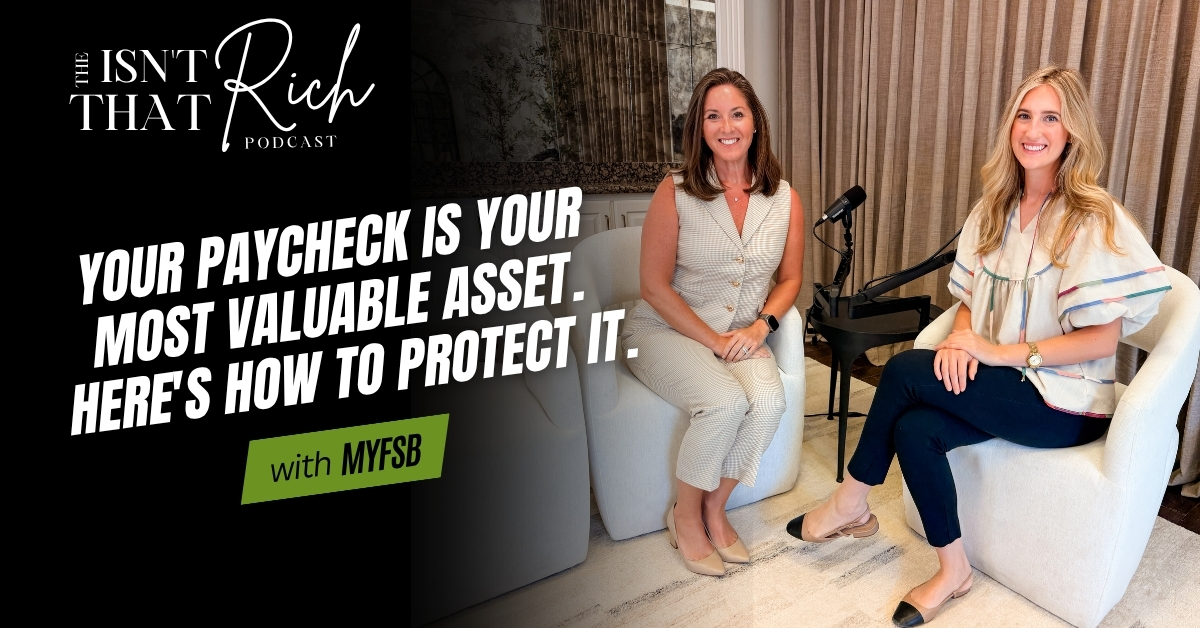
Your Paycheck Is Your Most Valuable Asset. Here's How to Protect It.
By: Jill Franks & Ashley McVicker
| Apple | Spotify | YouTube |
When we make a list of the things we insure, the house and the car are usually the first to come to mind. Those are the big ones, and they feel like the obvious things to protect. But for most of us who get up and go to work every week, the single most valuable thing we own is not sitting in the driveway at all. It is our ability to earn a paycheck. That paycheck covers the mortgage, keeps the lights on, and quietly funds everything else in our lives. So on this week's episode of Isn't That Rich, we sat down to talk about the one thing a lot of folks never think to protect, and that is your income. The way you protect it is with disability insurance.
It is not just the dramatic accidents
When people hear the word disability, they tend to picture some tragic accident that leaves a person completely unable to ever work again. That does happen, but it is not the usual story. What surprised us in putting this episode together is that about one in four people will become disabled at some point before they are very far along in life, whether that is short term or long term. It stays in the back of a lot of minds, and it really should not.
We have seen it firsthand with folks who have worked at the bank. Somebody takes short-term disability because they were ill for a couple of months, or there were complications during maternity leave and they needed a longer leave than planned. One coworker broke his hip, needed a big surgery, and was bedridden for weeks. He simply could not come into the office. You only have so much sick leave, and you only want to burn through so much vacation. That is exactly the kind of everyday situation this coverage is built for.
Here is the stat that really caught us. Close to ninety percent of disabilities are not related to a workplace accident. So workers' comp might step in about ten percent of the time, but the rest of the time, whatever happened to you happened away from the job, and workers' comp does not apply. And when you cannot come to work, your employer does not simply keep sending a paycheck. In a lot of cases you essentially lose the income altogether. That is the gap disability insurance is meant to fill. To be honest, Jill mentioned on the episode that she does not currently carry it, which is exactly why this is worth talking through, because so many of us put it on the back burner.
What disability insurance actually is
This is the piece people mix up most often, so let's clear it up. Health insurance pays the doctor. Disability insurance pays you. It replaces a portion of your income while you are unable to work, so your mortgage stays current and your lights stay on during your recovery. Think of it as a paycheck protection plan.
Short-term and long-term coverage
There are two basic kinds. Short-term disability covers a shorter window, usually a couple of weeks to a few months, often in the range of three to six months. This is the coverage for a surgery, a broken bone, or a stretch of treatments that keeps you home for a bit. Long-term disability picks up where short-term leaves off. It can pay out for years, sometimes all the way to retirement age, for something more serious or more permanent where you simply cannot go back to work. Imagine how life-changing a lasting disability would already be, and then imagine facing it without your normal paycheck. That is the situation long-term coverage steps in to soften.
Where to get it, and the gap most people miss
There are two ways to get disability insurance. If you are working, you can often get it through your employer, sometimes through a supplemental rep who comes into the office during open enrollment. You can also go buy your own policy on the open market and do your own research. When that rep comes around, the reaction is almost always the same, "I am young, I am healthy, I do not need to sit down at that table." But that is exactly the best time to get it, the same way it is with life insurance. You cannot predict when something will happen, so you buy it while you are well.
It helps to look at real numbers, because disability insurance usually pays a gap rather than your whole paycheck. Say you earn $60,000 a year, with $50,000 as your base and about $10,000 in bonus. A group plan that replaces sixty percent of your base pay would cover $30,000, or roughly $2,500 a month. So even with coverage in place, if your family was counting on the full $60,000, half of it is still gone. And group plans often leave out bonuses and commissions entirely, which raises a real question for anyone whose income is mostly commission-based, like a real estate agent. The whole point of the episode is this: look at all of your own numbers before something happens, not after. Whatever plan you are considering, make sure you know what percentage of your income it will actually replace.
There is also a tax wrinkle worth understanding. When your employer pays for the coverage, the benefit you receive is usually taxable, so that sixty percent shrinks even more once taxes come out. When you pay for your own policy with after-tax dollars, the benefit generally comes to you tax-free. A policy you buy yourself also travels with you if you change jobs, while employer coverage typically ends when you leave, just like a health plan. As Ashley joked, just do not trip and break your hip the day after you leave a job.
Own occupation versus any occupation
Not all disabilities are treated the same, and this is a detail really worth understanding. There are two main definitions to look for. An own occupation policy pays if you cannot do your specific job. An any occupation policy pays only if you cannot do any job you are reasonably suited for, which is a much harder bar to clear.
The example that makes it click is a dental hygienist who suddenly develops tremors in her hand and can no longer do that work. An own occupation policy would pay, because she can no longer do her specific job, even if she could technically go answer phones somewhere else. An any occupation policy might deny that same claim, since she could still hold some kind of job. So own occupation pays more readily, and because of that it usually costs a little more. As with most insurance, you are taking your best guess at what the future holds.
What it costs
This is what most people really care about. A long-term policy generally runs about one to three percent of your annual income per year. It is not a set figure for everyone, so they look at your numbers to land on a policy. Running the math on a $50,000 earner, that comes out to roughly $500 to $1,500 a year, or about $40 to $125 a month depending on the details. That is decently affordable for protecting your entire paycheck. What moves the price is your age, your health, whether you have had a disability in the past, the kind of work you do, and whether you choose own occupation or any occupation coverage. The healthier you are, the lower the number tends to be, which is one more reason to sit down with a professional and look at your own situation.
One more number worth knowing is how much coverage to aim for. A common target is to replace about sixty to seventy percent of your income, so that gives you a realistic floor to shoot for when you compare policies.
Do not count on Social Security alone
A lot of folks quietly assume that if they became disabled, Social Security would simply kick in and take care of everything. It can help, but it leaves a big gap, and there are three big reasons it is not enough on its own.
First, it is hard to qualify for. Social Security uses a strict definition of disability. Your condition has to keep you from working at a substantial level and be expected to last at least a year, or be terminal. There is no short-term disability in the Social Security world at all. It has to be long-lasting or permanent, so it simply does not cover the shorter situations that regular disability insurance would.
Second, you can lose it if you try to go back to work. The whole program is built on the idea that you cannot work. So if you take a different job and start earning above a certain threshold, Social Security stops paying your benefit. This traps a lot of people, who realize they cannot work more than part-time without losing everything, and their benefit may be worth more than what they could actually earn going back. In 2026 that earned-income limit is about $1,690 a month, which is not much to live on. Earn beyond it and they start pulling your benefit back.
Third, the amount is small to begin with. It is based on your own earnings record, so it comes out to a small portion of what you were making before, nowhere near your normal salary. Put those three things together, hard to qualify for, easy to lose if you work again, and modest even when approved, and you can see why a private policy matters so much. Disability insurance fills the gap between what Social Security might pay and what your paycheck was actually worth.
Who needs this most
If your family depends on your income, this is for you, and that goes double if you are the main earner. We often throw around the stat that most Americans could not come up with $400 for an emergency. If that is true for so many households, then a lot of those same households could not go a single week without a paycheck either. People really do live paycheck to paycheck, and this coverage could be the help that carries them through.
It matters even more for the self-employed and small business owners, because there is no HR department and no benefits package quietly setting up a safety net. A lot of folks who start a business simply do not have anything in place yet. To our younger listeners who are single or feeling invincible, now is exactly the time to buy, precisely because you do not think you need it. You could blow out your back playing pickleball today, or end up in a car accident, and suddenly not be able to do the manual-labor job you have done your whole life. With a stat like one in four, the odds are not as far off as they feel.
Ashley shared a good gut-check on the show. At one of her first jobs out of college, she signed up for a fully covered policy that cost her a couple of dollars a paycheck, back when she knew next to nothing about insurance, and looking back, that was a smart pick. Yet more recently she turned down coverage that ran only about ten to fifteen dollars a month, mostly out of that superstitious feeling that buying it might somehow invite bad luck. It will not, and skipping it is the real risk.
The bottom line
Your income is the asset your whole financial life is built on, and protecting it is not being paranoid. It is being smart. If your workplace has a rep come sit down with you, take that twenty-minute meeting and pick their brain about what a policy could mean for you. Check whether you are already covered, the same way we have been encouraging everyone lately to check their beneficiaries. Do not save this for the once-a-year visit when you renew your home and auto policies. Put it near the top of the list, because unlike those, this coverage pays you, not the doctor.
If you would like help figuring out what a policy would look like for your situation, the team at FSB Insurance is happy to walk you through it, with no pressure at all.