

Brock Newman's Guide to Saving in Your 20s
By: Jill Franks & Ashley McVicker
| Apple | Spotify | YouTube |
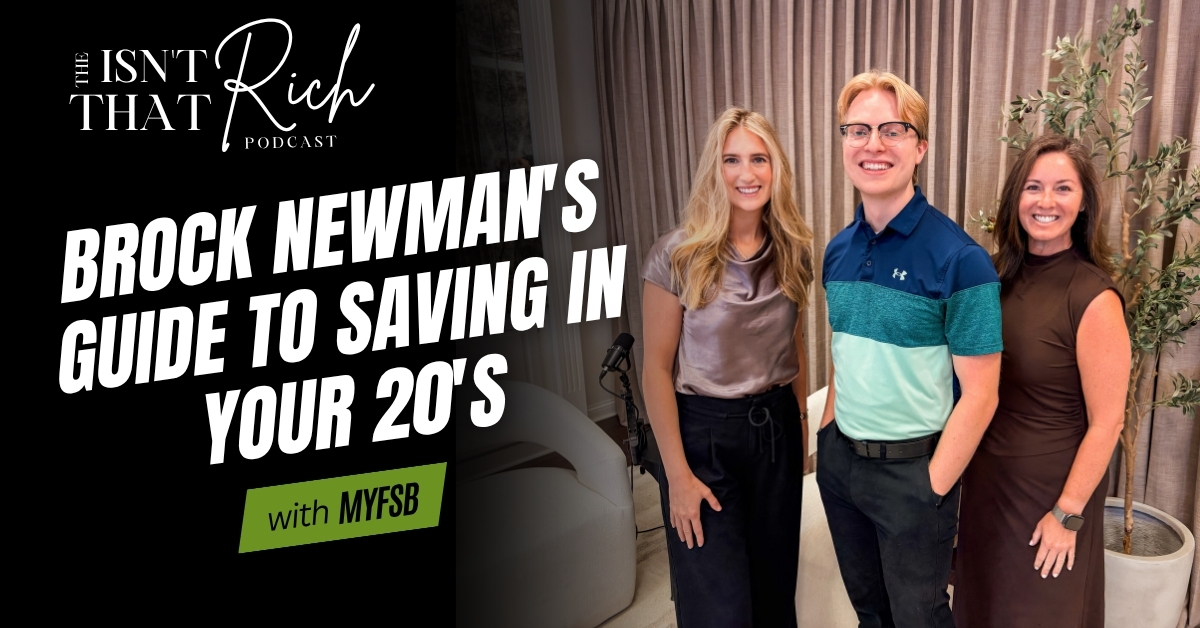
Some of our best money conversations happen in a small office at our Harrisburg branch, across the desk from a 21-year-old named Brock Newman. Brock is our new accounts rep in Harrisburg. He's the person you sit down with when you open your first checking account or start a savings account, and he's been with Farmers State Bank for about three years, starting right out of high school.
Brock joined us on Isn't That Rich during his very first hour in the marketing department as part of our mentorship program. We didn't waste any time. We put him in front of a microphone and asked him to talk about something close to his heart: how young people can start saving, and why their teens and early 20s might be the best saving years they'll ever have.
From the CEO Program to the New Accounts Desk
Brock first got to know FSB through the Saline County CEO program, a business class for high school juniors and seniors that skips the classroom entirely. Students tour local businesses and hear from community business leaders, and one of those stops was our bank. Brock left that visit thinking maybe he could work here. A buddy who already worked at FSB told him it would be a good fit, so he put his application together.
Here's a fun behind-the-scenes fact: Jill still uses Brock's cover letter as an example for other people. It's the best one she's ever read, and his thank-you letter was just as good. Brock gives the credit to the CEO program, which brought in speakers to teach students how to build a resume and write a cover letter before they ever applied anywhere. If you're a student with the chance to join a program like that, take it.
A Day in the Life (Spoiler: No Two Are the Same)
Ask Brock what his day looks like and he'll tell you he stopped trying to predict it a long time ago. That's part of what keeps it fun. At the heart of his job is helping whoever walks through the door, whether they need help with an account they already have or want to open a new one. He's also a go-to contact for many of our business customers, who email him with everything from online banking hiccups to sending out a wire.
For a lot of customers, Brock is the very first person they meet at FSB. Those conversations usually start with where someone banks today and what they're looking for, so we can figure out whether we're a good fit. Sometimes the honest answer is that we're not, and that's okay.
Young customers hold a special place for him. Plenty of 18-year-olds come in on their own, without a parent, opening their first account and flying blind. Brock tells them it wasn't that long ago he was in their shoes with no idea what he was doing. He hands them a folder with his contact information and lets them know no question is too small, even something as simple as how to write a check.
"I didn't know that I could just go and ask my bank these simple questions," he told us. "But now I realize that is my entire job."
What Brock Learned in Mentorship
Our mentorship program gives employees about two weeks to see how every corner of the bank works. Brock joked that it would probably take 15 years to learn every in and out, but two weeks gives you a good glimpse. The goal is to understand how your job affects your co-workers and to see what other roles might interest you down the road.
His biggest surprise came at our Operations building. From the deposit side, Brock figured everyone in loan operations did about the same thing. After sitting with four or five departments there, he learned each one wears a million hats, and there's a lot more to it than typing up loans. It gave him some perspective on timelines, too. Title work and appraisals can take a couple of weeks, so a loan can't always be wrapped up the day the paperwork comes in.
He learned something about himself along the way. Brock is a people person, and while he loved getting to know his Operations co-workers, he knows now that a customer-facing role is where he belongs. Spending time with our lenders and loan assistants showed him some of their work lines up with what he already loves about his job. And for the record, he says marketing is his favorite department. We're choosing to believe him.
Your First Paycheck: Start With a Checking Account
For his topic, Brock picked something he's passionate about: saving as a teenager or 20-something. So what would he tell someone his age who just got their first paycheck and has nothing saved yet?
Step one is simply opening a checking account. A lot of young people cash their paychecks or hang on to the cash they make in tips, and others lean on app-based cards like Chime. The trouble with cash is that you never really know where it's going. A checking account gives you a record, so you can actually see what you're spending.
Next, Brock likes to open a savings account right alongside it. He'll figure out how much of the paycheck you need until next payday and move the rest into savings. If the whole check is already spoken for, no problem. Savings can wait for another day.
The bigger goal is building the habit. Even with an account, plenty of people live by the rule that as long as they're not in the red, they're fine. Brock wants to help young people trade that mindset for a savings cushion they can fall back on, because there will always be a moment when you need it.
Why Your Teens and Early 20s Are Your Prime Saving Years
Brock hears it a lot from young people living at home: this is the time when I'm free to spend my money. He sees it the exact opposite way. With fewer bills now than you'll have for the rest of your life, this may be when you can save the most.
That doesn't mean sitting at home every weekend. Brock is quick to say there's a balance, so go to the movie with your friends and have fun. The point isn't to save every single dollar. It's to save some dollars. Ashley added that a little delayed gratification goes a long way here. Letting money sit for a while before you decide what to do with it can be really rewarding later on.
How Brock Does It
When Brock started working, he took some time to figure out what his typical monthly expenses looked like and where he could trim the fat. His confession: he eats out a little too much. (His Harrisburg co-workers lovingly call him the garbage disposal, and he will never turn down a spare mozzarella stick at lunch.)
Once he knew his numbers, his first goal was an emergency fund. If everything hit the fan tomorrow, could you handle it? Now he moves every extra dollar into savings with an automatic weekly transfer, so it's out of sight and out of mind.
At 21, Brock still lives at home so he can save as much as possible before he moves out. He has nothing against anyone who leaves the nest at 18 or 19. But if a rent-free option is on the table, it's a great chance to make the most of those saving years.
Credit Cards: A Good Tool in the Right Hands
Brock doesn't see many young people applying for credit cards at the bank. Most of our credit card users are middle-aged. His take is that a credit card isn't one-size-fits-all.
If you're disciplined and already good at saving, a credit card can be a smart move. If you're still struggling to build savings, it could dig you into a deeper hole. His rule of thumb is simple: never put more on the card than you have in your checking account. If you aren't sure you can pay the balance in full at the end of the month, it's okay to wait.
For a first card, a secured card is a great place to start. You put down a deposit, often a few hundred dollars, and that becomes your spending limit. Many card companies will review your account after several months of on-time payments and may give your deposit back and move you to a regular card. Look for one with a good intro offer and solid rewards.
Once you have a card, Brock's best advice is to use it for something small each month, like gas, and pay the full balance every time. Set up automatic payments so you don't even have to think about it. Keeping your balance low compared to your limit helps your credit score. If you have a $1,000 limit and spend the whole thing every month, you're using all of your available credit, and that can hold your score back even if you pay it off. Carrying a balance is worse, because the interest hits every single month and eats into the savings you've worked so hard to build.
The other mistake Brock sees is the opposite one: people who are in a great position to use a card responsibly but avoid it like the plague. Jill pointed out why that matters. Once you move out, your credit history comes up for everything from renting an apartment to hooking up utilities, and with little or no history a company like Ameren may ask for a deposit before turning on service. Building some credit early pays off.
Investing: Follow the Order of Operations
Once you're a solid saver with an emergency fund that could carry you a few months if everything went wrong, Brock says that's when investing comes into play. Just don't put your life savings into the stock market right off the bat.
His own system has a fun name. Brock keeps a savings account titled "pre-investments," a holding spot for money headed toward a big purchase or the market. Once a month, an automatic transfer moves money from that account into stocks through a local broker in Harrisburg. Steady contributions mean he's buying when the market is down and when it's up. And when the market drops, he sees it as stocks going on sale.
Time is a young investor's biggest advantage. Every dollar you put in at 18 or 19 has decades to grow through compounding, and you have time to recover from the market's ups and downs. That's exactly why the emergency fund matters so much. When your refrigerator goes out, you want to pull from savings, not sell stocks on a down day. As Brock put it, there's an order of operations, and getting it right is what lets you take a little more risk for bigger returns.
Ashley loved that Brock is talking about brokerage accounts, because not every job offers a 401(k) right away. And with the new Trump Accounts, families now have a way to start investing for kids even before they turn 18.
Not Ready for the Market? Try a CD
If stocks feel like too big a leap, Brock suggests a CD as a baby step. Even a short-term CD of three or six months helps you get used to putting money away and leaving it alone. Once your CD balances grow, you can move some of that money into the market.
Ashley can vouch for this one. When she opened a six-month CD, she didn't love locking her money up. Six months later, she'd forgotten all about it and is thinking about locking it up again.
We also offer IRAs at FSB. Ours are invested in CDs rather than stocks, which makes them a favorite for retired customers who want guaranteed returns and don't want to worry about a market dip.
Saving for a House Isn't Out of Reach
Brock gets it. A lot of people his age feel like buying a house is impossible, and he's felt that way himself. But he's convinced it can be done.
His advice is to build a separate down payment fund instead of dipping into your emergency fund. Where you keep it depends on your timeline. If you think you'll buy within about six months, keep it in cash in a savings account where it's easy to reach. If you're a couple of years out, investing it gives it time to grow and bounce back from any dips. Just know you're trading away some flexibility, since nobody wants to sell the week the market happens to be down.
Ashley reminded us that a home is an investment, too. It builds equity over time, just in a different way than the stock market does.
Here's the plot twist Brock picked up during mentorship. He'd been planning on a big down payment all along, until he sat down with John Streuter, one of our mortgage lenders in Marion. That's when he learned there are loan programs with a low down payment, or even none at all. That could let him keep his money growing when the right house comes along. Game changer! If you've been assuming homeownership is years away, a quick conversation with one of our lenders might surprise you, too.
Brock's Best Advice: Start Small and Stay Disciplined
We covered a lot of ground, and if you're 16 or still in school, it might feel like a lot. Brock says you don't need to remember every step. What matters most is discipline. Find people who are where you want to be and let them guide you while you build the habit.
If saving a couple hundred dollars a week sounds like too much, start with $10 a week for three months. Pick a next step that's manageable but still takes a little work. Once you've got it down, move on to the next one. Before you know it, you could be investing in the stock market or putting a down payment on a house.
Come See Brock in Harrisburg
Brock wants you to know his door is always open. He used to think asking your bank simple questions was off limits, and now answering them is his favorite part of the job. If you're a young person with questions about saving or opening your first account, stop by our Harrisburg branch or give him a call at 618-252-2600.