

MyFSB Book Club: The Psychology of Money
By: Morgan Housel
| Apple | Spotify | YouTube |
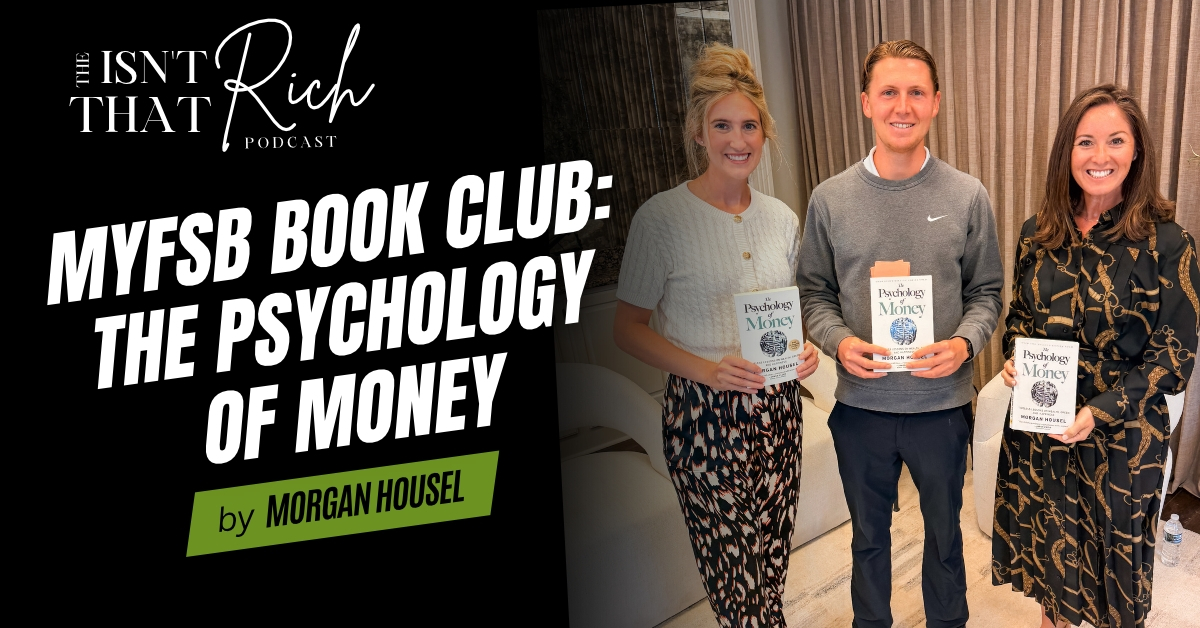
Book club day is one of our favorite days on Isn't That Rich, and this one came with a bonus guest. For September and October we read The Psychology of Money by Morgan Housel, and Mitchell Cagle from our Farmers State Bank team read right along with us. Once we found out he was reading it, we knew we had to get him on the show.
We loved this book. It's an easy, fun read, and all of us saw a little bit of ourselves in its pages. The big idea is one we come back to all the time on this podcast: the way you think about money is the way you'll spend it and treat it. Here's our recap of the conversation, chapter by chapter.
No one's crazy about money
The book opens with a reminder that everybody's experience with money is different. Where you grew up, how old you are, what your family taught you and what happened in the economy along the way all shape how you handle a dollar. Jill finished college in 2008, right as the market took its big downturn, and that shaped how she thinks about money in a way someone a few years younger might never feel.
Mitchell knows this firsthand. He and his brothers grew up in the same house, and they still spend money completely differently. One brother might drop $100 on something that makes Mitchell ask, "Why would you do that?" And if you grew up begging for the McDonald's drive-thru, you probably heard the same answer he did: we have food at home.
So what's Mitchell's money profile? He's a big saver and always has been. (His apartment is not exactly overflowing with decorations.) When he does splurge, it's on experiences, like a hockey game or a jersey, and he'd rather not see the price tag. Ashley is more of a spender on things she sees as quality, and Jill is a saver too. None of those are wrong. They're just shaped by the lives we've lived.
Luck, risk and knowing when you have enough
Is getting rich about luck or about taking smart risks? The book's answer is a little of both. Bill Gates was brilliant and worked hard, but he also went to one of the only schools around with a computer. His close friend from those days, just as gifted, died young and never got the chance to build what Gates did. Warren Buffett had his own good fortune: he studied under Benjamin Graham, one of the giants of investing, and went on to work for him. Having the right mentor can change everything.
That's a good reminder before we judge where someone else has landed in life. Sometimes it really is the luck of the draw, good or bad.
The next chapter, "Never Enough," hit close to home. We're wired to keep wanting more, and that might be the biggest money trap there is. We asked each other whether our definition of "enough" changes when we start earning more. Honestly, it does. The goalpost keeps moving, partly because the economy moves and partly because we keep looking at what everybody else has.
Our favorite story in this chapter: an author at a fancy party is told that their host, a hedge fund manager, made more in one day than the author ever made from his famous book. His reply was that he had something the hedge fund guy would never have. He had enough.
It helps to look back at what you earned at 21 or 22. It wasn't much, but there was always food on the table. That perspective helps. So does remembering that more money usually means more of your time spent earning it, and sometimes our personal time is worth more to us than the extra paycheck.
Warren Buffett, Walt Disney and the power of time
Is Warren Buffett a genius, or did he just have a lot of time? Our vote: a little luck, a little risk, a lot of skill and a whole lot of time. Mitchell pointed out something none of us had realized. Buffett earned most of his fortune after he turned 60. The biggest wins came late, because compounding needs years to do its work.
So what would we tell someone in their 20s who plans to start investing "once I make more money"? Start now, even if it's $10 a week. Have it transferred out automatically, count it in your budget and don't look at it. Hindsight always makes us wish we'd put in more and spent less on things we bought to impress people.
The book also separates getting wealthy from staying wealthy. Jesse Livermore made a fortune betting against the market in the 1929 crash, coming home to tell his panicked wife it was the best day ever. He later lost it all. Mitchell thinks staying wealthy is the harder part. It's easy to spend, and we've all seen headlines about pro athletes and celebrities going broke.
Walt Disney is the flip side. Steamboat Mickey came long before Disney really paid off with Snow White, and there were plenty of misses in between. You can be wrong most of the time and still come out ahead if you keep going. Not everything has to work. One good idea could turn into a theme park.
And then there's freedom. Your time is the most valuable thing you own, and being able to choose how you spend it, and who you spend it with, is the real reward of money. The book tells of a surgeon who spent years chasing that career, only to discover he hated it. Because he'd saved, he could walk away and coach his kids instead. That's the goal.
The man in the car and the wealth you can't see
This was one of our favorite chapters. When you see someone driving a Ferrari, they probably assume you're admiring them. You're not. You're picturing yourself behind the wheel. Nobody is thinking, "I want to be that person." They just want the car.
We also make big assumptions about people based on what they drive. As one of our moms likes to say, anybody can lease a car. That doesn't make them wealthy. The person in the flashy car may have spent every dollar they had to look rich, while the guy in the beat-up truck could be sitting on a healthy savings account. We learned the practical side of this at a recent parade. Driving a low-clearance Corvette sounds fun until you spend the whole route terrified of scraping it.
That leads right into "Wealth Is What You Don't See." Real wealth is the money you didn't spend. Two people can earn the exact same income, but the one with the higher savings rate ends up with more freedom down the road. A $25,000 designer handbag on Instagram is not wealth. A paid-off house and zero debt is, and you'd never know it by looking at someone.
The book's afterword adds some fun history here. After World War II, millions of veterans came home, interest rates stayed low and spending took off on new houses and new appliances. That consumer boom still shapes how we think about money today.
Save money (just because)
We all got fired up about this one. Most money advice tells you to save for something specific, like a house fund or a vacation fund. Those are great. But Housel goes a step further and says to save simply for the sake of saving, because life will surprise you, and you'll be so glad the money is there when it does.
Case in point: nails on the road. Mitchell had a tire go flat out of nowhere, and so did his dad. One of us picked up two nails in a single week, the first on the drive home from the St. Louis airport. Without savings, a surprise like that turns into a loan, and then you're paying interest on top of the repair. (And if you're hauling nails in your truck, please secure them so the rest of us can keep our tires and our savings accounts.)
Reasonable over rational
You don't have to make the mathematically perfect choice every time. A reasonable plan you actually stick with beats a "perfect" one you abandon. The book points to two Yale academics who once suggested young people borrow to invest two-to-one in the stock market. Rational on paper, maybe. Reasonable? Not for most of us.
We loved the fever example. A fever actually helps your body fight infection, so rationally you might want one. But it makes you miserable, so we take something to bring it down. That's the reasonable choice. Money works the same way. A strict pen-and-paper budget doesn't work for everyone, and that's okay. What matters is knowing when you can say yes and when you need to say no. One easy trick: if you see something you want, wait a couple of days. If you still want it and you've got the cushion, go for it.
Surprises, second chances and playing your own game
History is useful, but the biggest events are usually the ones nobody saw coming. We've lived through a pandemic and watched what it did to the stock market and the housing market. If only we'd bought everything in 2020! The lesson isn't to predict the next surprise. It's to leave yourself room for error, because no financial plan goes perfectly. As one of us put it, we can't even get tomorrow's rain forecast right, so why would we trust anyone to forecast the economy?
The book also reminds us that we'll change, more than we expect. Mitchell planned to be a nurse in high school. One of us started college as a pre-dental student before realizing a blood draw was already too much. Now we're all in banking, which none of us saw coming. Our money goals shift the same way as life happens to us.
We're also all playing different financial games. Someone about to retire should not be making the same moves as a 24-year-old just getting started. That's why it pays to be careful with financial advice from social media influencers. Their goals may look nothing like yours, and you have no idea what debt they might be hiding. If you don't have an emergency fund yet, that's your next step, even if your friends are booking trips to Disney World.
Bad news sells (and we buy it)
Good news rarely makes headlines. A great day in the market barely gets a mention, but one bad day is everywhere. Pessimism sounds smart, and it keeps us clicking. One of us admitted to making decisions off a single news article, so this chapter was a real wake-up call. A good tip if that sounds like you: take a 30-day break from financial news to reset your thinking. Staying positive is one of our core values at Farmers State Bank, and it turns out it's good for your portfolio too.
The next chapter covers how we'll believe almost anything we badly want to be true. One of us bought Cracker Barrel stock after its rebrand backlash, fully convinced it was headed for the moon. It wasn't. A brother who reads stock charts zoomed out to the five-year view and showed it had been sliding long before the rebrand. The full picture would have told a different story.
We all have incomplete views of the world. Think of those videos where kids explain what their parents do for work. Mitchell only knew that his mom showed up to his games in scrubs and his dad wore dress clothes. Turns out she's a dental hygienist and he's a credit officer at a bank.
Our biggest takeaways
We each walked away with something different. One of us is going to work on seeing the full picture instead of reacting to the latest headline. Another took to heart the idea of making money decisions that let you sleep at night, especially once you're making them for your kids' future too. And one of us needed the reminder that there's no perfect way to invest. If you're saving more than you spend and putting something toward your future, you're doing enough.
A big thank you to Mitchell for reading along and joining us on the mic. He was nervous about being on camera, but you'd never know it. We hope he'll be back for another book club soon.
Want to talk money with a real person? Stop by any Farmers State Bank location in Alto Pass, Harrisburg or Marion. We'd love to see you.
Listen to the full episode of Isn't That Rich wherever you get your podcasts, and subscribe to our newsletter so you never miss a book club pick. See you next week!